

The Gokyo Cho La Pass trek complete guide covers a 16-day circuit through the Everest region combining the turquoise Gokyo Lakes, the 5,357 m Gokyo Ri viewpoint, the challenging 5,420 m Cho La Pass crossing, and Everest Base Camp in a single continuous route — the most complete Khumbu adventure available on one trek.
Gokyo Cho La Pass trek complete guide answers the question every experienced Khumbu trekker eventually asks: why choose between Gokyo Lakes and Everest Base Camp when a single route covers both? The Gokyo Cho La Pass trek links the two finest destinations in the Everest region. It crosses the Cho La Pass at 5,420 m, connecting the wild Gokyo Valley on the west with the classic Khumbu corridor on the east. Our team guides this route every season. Furthermore, we consider it the most rewarding multi-destination trek in all of Nepal for trekkers who have the fitness and experience to handle it. This guide covers every detail: itinerary, cost, permits, difficulty, gear, and best season.
What Is the Gokyo Cho La Pass Trek?
The Gokyo Cho La Pass trek is a high-altitude loop in the Khumbu region of the Solukhumbu district, combining two of Nepal’s most celebrated trekking destinations into one extended circuit. The route begins with a flight to Lukla. It follows the classic Everest trail through Namche Bazaar before branching west into the Gokyo Valley. After the Gokyo Lakes and Gokyo Ri at 5,357 m, the trek crosses the glaciated Cho La Pass at 5,420 m. The descent leads to Dzongla and Lobuche on the Everest Base Camp corridor. The circuit finishes with the classic EBC approach to base camp at 5,364 m. From there, Kala Patthar at 5,644 m offers the highest viewpoint before the return to Lukla.
Additionally, this combined circuit visits four of the Everest region’s finest viewpoints in one journey: Gokyo Ri, Cho La Pass, Everest Base Camp, and Kala Patthar. Neither the standard Gokyo route nor the standard EBC route delivers all four. Those comparing this route against the simpler Gokyo-only option should read our EBC vs Gokyo Lakes Trek comparison for a detailed breakdown of both alternatives.
Gokyo Cho La Pass Trek at a Glance
Gokyo Cho La Pass Trek — 16-Day Itinerary
For the full day-by-day itinerary with altitude profiles and stage maps, visit our Gokyo Cho La Pass Trekking page.
What Makes the Cho La Pass Crossing So Challenging?
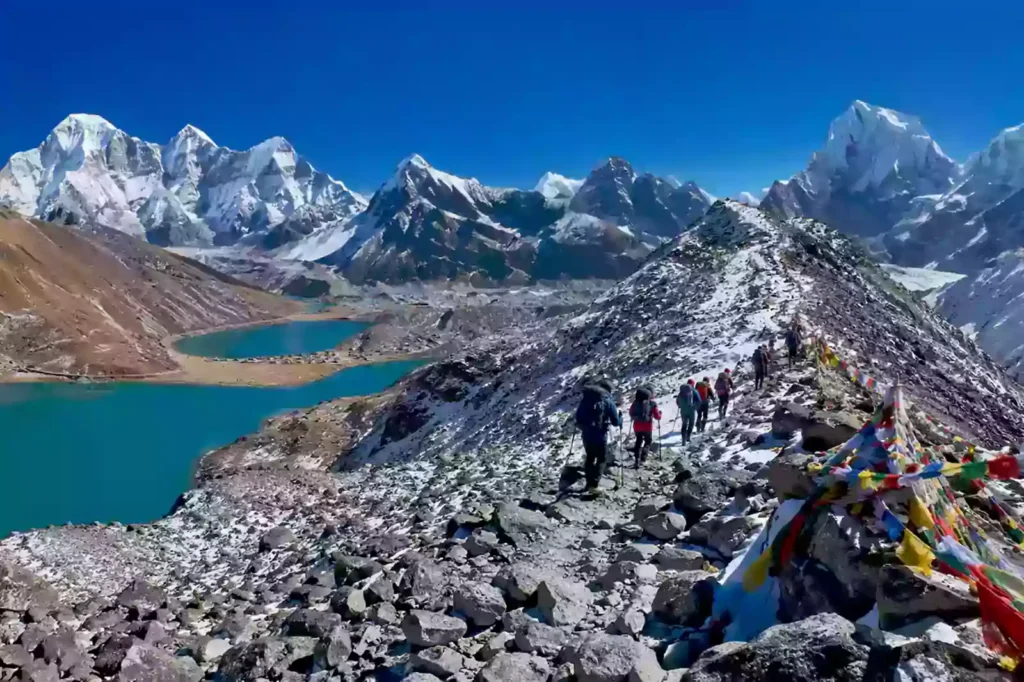
The Cho La Pass at 5,420 m is the defining physical challenge of this trek. The crossing demands an early start — typically 4:00 to 5:00 a.m. — to clear the pass before afternoon weather deteriorates. The ascent from Thangnak is steep and glaciated, requiring careful footwork on ice and snow. Consequently, microspikes or crampons are essential for the final approach. The descent on the eastern side is equally steep and rocky.
Furthermore, our guides assess pass conditions every morning before departure. In heavy snowfall or poor visibility, we delay the crossing by one day. Safety always comes first. Severe winter snowfall or unseasonal storms can close the pass temporarily in any season. Nevertheless, in spring and autumn under normal conditions, fit trekkers with proper gear complete the crossing without technical difficulty. Those who have completed the Everest Base Camp trek training plan will find themselves well prepared for the physical demands of the pass day.
What Are the Gokyo Lakes?
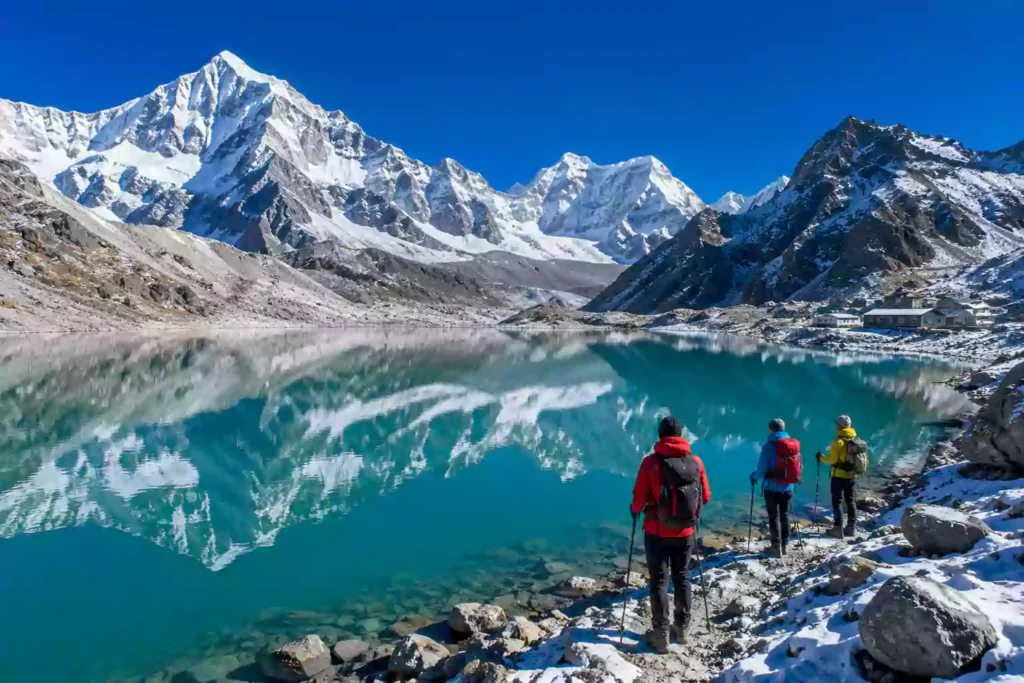
The Gokyo Lakes are a series of six high-altitude glacial lakes in the Gokyo Valley, ranging from Longponga at 4,690 m to the upper Fifth Lake at approximately 5,000 m. The first three lakes are the most visited. Gokyo village sits beside the Third Lake at 4,790 m and serves as the main base for accommodation in the valley. Notably, the lakes carry a deep turquoise colour from glacial meltwater. On clear mornings, Cho Oyu (8,188 m) reflects in the still water. It is one of the most striking mountain reflections in Nepal.
Gokyo Ri at 5,357 m sits 2 to 3 hours above the village. From the summit, trekkers enjoy one of the finest panoramas in the entire Himalayas. Specifically, four peaks at 8,000 m appear simultaneously: Everest (8,849 m), Lhotse (8,516 m), Makalu (8,485 m), and Cho Oyu (8,188 m). Additionally, the Ngozumpa Glacier — the largest glacier in Nepal — stretches south from Cho Oyu directly below the viewpoint. Those interested in the broader Gokyo experience without the Cho La crossing can explore our Gokyo Lake Trek page for the standard Gokyo-only itinerary.
How Difficult Is the Gokyo Cho La Pass Trek?
The Gokyo Cho La Pass trek complete guide rates this route as strenuous. Daily walking time runs 6 to 8 hours across remote, high-altitude terrain. The trek spends multiple consecutive nights above 4,000 m and crosses two points above 5,300 m. Therefore, it suits experienced trekkers with prior high-altitude experience above 4,000 m rather than complete beginners.
The most demanding sections are:
- Cho La Pass crossing (Day 9): Glaciated ascent at 5,420 m with an early start and 7 to 8 hours total walking
- Gokyo Ri summit (Day 8): 600 m vertical gain from Gokyo village at 4,790 m
- Kala Patthar (Day 12): Pre-dawn ascent to 5,644 m before descending to Pheriche
Trekkers who have done the Manaslu Circuit Trek or a similar strenuous route will find this a natural next-level challenge.
What Permits Do You Need for the Gokyo Cho La Pass Trek?
Two permits are required for the Gokyo Cho La Pass trek in 2026:
Our guides collect all permits before departure from Kathmandu and manage all checkpoint procedures. Under Nepal’s 2025 mandatory guide regulation, introduced by the Nepal Tourism Board and TAAN (Trekking Agencies’ Association of Nepal), all foreign trekkers in national park areas must trek with a government-certified licensed guide. Our trekking permit guide covers the full 2026 fee structure and application process.
How Much Does the Gokyo Cho La Pass Trek Cost in 2026?
A fully guided 16-day Gokyo Cho La Pass trek with Nepal Footprint Holiday costs between USD 1,300 and USD 1,800 per person for a private trip. Below is a transparent cost breakdown:
Booking directly with Nepal Footprint Holiday saves 20 to 35 percent compared to international booking platforms. Additionally, group joining departures cost significantly less than private trips.
What Gear Do You Need for the Gokyo Cho La Pass Trek?
The Cho La Pass crossing demands cold-weather gear beyond standard EBC kit. Our guides verify every trekker’s equipment before departure from Kathmandu:
- Down sleeping bag: Rated to -15°C minimum for nights above 4,500 m
- Down jacket: High-loft, for evenings and the pre-dawn Cho La start
- Microspikes or crampons: Mandatory for the glaciated Cho La approach
- Trekking poles with snow baskets: Balance on icy descent sections
- Waterproof insulated boots: Well broken-in before departure
- Layered hand protection: Liner gloves plus insulated outer gloves
- Balaclava and warm hat: Wind chill above 5,000 m is significant
- Sunglasses with UV400 protection: Glacier glare on Cho La is intense
Our full trekking equipment guide covers every item with brand recommendations and what to rent or buy in Kathmandu or Namche Bazaar before heading higher.
When Is the Best Time for the Gokyo Cho La Pass Trek?
Spring (March to May) and autumn (September to November) are the only seasons our team recommends for this trek. In particular, October delivers the clearest mountain views and the most reliable Cho La Pass conditions. April and May bring excellent visibility before the pre-monsoon haze builds. Additionally, the rhododendron forest below Namche is in full bloom.
Winter crossings of Cho La from December to February are possible for very experienced trekkers but carry real risk of pass closure due to snow accumulation. The monsoon from June to August brings heavy cloud and wet lower-trail conditions. Therefore, we do not operate this route in monsoon. Our trekking season guide covers monthly conditions across the full Khumbu region in detail.
Is Altitude Sickness a Risk on the Gokyo Cho La Pass Trek?
Yes. The Gokyo Cho La Pass trek spends more consecutive nights above 4,000 m than the standard EBC route and crosses multiple points above 5,300 m. Altitude sickness is a genuine risk that our guides take seriously on every departure. We carry pulse oximeters, supplemental oxygen, and a Gamow bag on all departures. Our acclimatisation schedule builds in two rest days — one in Namche and one in Gokyo. Consequently, trekkers arrive at the Cho La crossing properly adapted. Read our full altitude sickness guide before booking this trek.
“The moment that defines the Gokyo Cho La Pass trek for most trekkers is standing on Gokyo Ri at sunrise with Everest, Lhotse, Makalu, and Cho Oyu all above 8,000 metres lined up in front of you. Then two days later you are standing at the foot of Everest itself. No other trek in Nepal gives you both of those experiences in one journey.” — Nepal Footprint Holiday senior guide, Khumbu region specialist with 13 years of field experience.
Government of Nepal registered · Kathmandu-based · 10+ years guiding experience
Frequently Asked Questions
Q1. How difficult is the Gokyo Cho La Pass trek?
The Gokyo Cho La Pass trek is rated strenuous. Daily walking runs 6 to 8 hours across high-altitude terrain above 4,000 m. The Cho La Pass crossing at 5,420 m involves a glaciated ascent requiring microspikes and an early pre-dawn start. The trek suits experienced trekkers with prior high-altitude history above 4,000 m. It is not recommended for first-time high-altitude trekkers.
Q2. How much does the Gokyo Cho La Pass trek cost in 2026?
A fully guided 16-day private Gokyo Cho La Pass trek costs between USD 1,300 and USD 1,800 per person with Nepal Footprint Holiday. Total all-inclusive budget including Lukla flights, permits, guide, porter, accommodation, meals, and travel insurance runs USD 1,650 to USD 2,650 per person. Booking directly with a Kathmandu-based operator saves 20 to 35 percent compared to international platforms.
Q3. What is the best time for the Gokyo Cho La Pass trek?
October and November are the best months for the Gokyo Cho La Pass trek. Post-monsoon skies are crystal clear, the Cho La Pass is fully open, and mountain views from Gokyo Ri and Kala Patthar are at their finest. March to May is the second-best window with excellent visibility and rhododendron blooms on the lower trail. December to February carries real Cho La Pass closure risk and is not recommended for most trekkers.