

Mera Peak Nepal highest trekking peak guide in brief: Mera Peak at 6,476 m (21,247 ft) is the highest officially classified trekking peak in Nepal, located in the Hinku Valley of the Everest region, southeast of Island Peak. It is a non-technical snow climb graded F (Facile) in alpine terminology, first summited on 20 May 1953 by Colonel J.O.M. Roberts and Sen Tenzing. The standard 16-day climbing package from Kathmandu approaches via Lukla and the Hinku Valley wilderness, crosses the Mera La Pass at 5,415 m, and culminates in a high-camp summit push offering a 360-degree panorama of five 8,000 m peaks: Everest, Lhotse, Makalu, Cho Oyu, and Kanchenjunga. The all-inclusive package price with Nepal Footprint Holiday is US$2,500 per person.
For first-time high-altitude climbers who want to stand above 6,000 m without the technical rope skills required on peaks like Island Peak or Lobuche East, Mera Peak is the most logical and rewarding entry point in Nepal’s entire trekking peak portfolio. This guide covers everything: the three summits, the approach, the itinerary, gear, permits, altitude risk, best season, and how Mera compares to its neighbours.
Why Mera Peak is Nepal’s highest trekking peak: what that title actually means
The Nepal Mountaineering Association (NMA) classifies trekking peaks separately from expedition peaks. Trekking peaks are generally lower and less technically demanding mountains. Climbers can attempt them with a trekking peak permit and a registered guide instead of a full expedition permit and a licensed climbing expedition team. Nepal has 33 NMA-classified trekking peaks, and Mera Peak stands as the highest at 6,476 m.
One important clarification: some older sources list Mera Peak at 6,654 m, but that figure is incorrect. It actually refers to nearby Peak 41, which an early list of Himalayan peaks mistakenly labelled as Mera Peak. The error later appeared in official records as well. The correct NMA-registered elevation of Mera Peak is 6,476 m, which the Nepal Mountaineering Association and Nepal Footprint Holiday use in their current descriptions.
Mera Peak has three distinct summits. At 6,476 m, Mera North is the highest and serves as the standard summit objective for most climbing groups. Climbers also commonly attempt Mera Central, which reaches 6,461 m, while the lower Mera South stands at 6,065 m and sees fewer ascents. Unless specified otherwise, trekking companies and climbers generally use “Mera Peak” to refer to Mera North.
The Mera Peak approach: Hinku Valley
The character of the Mera climb is defined as much by its approach as by the summit itself. Unlike Island Peak, which approaches along the main Everest highway through Namche, Tengboche, and the Khumbu corridor, Mera Peak enters Nepal’s mountains through the Hinku Valley: a quieter, wilder route that sees a fraction of the Everest trail’s foot traffic.
The approach leaves Lukla on a separate trail heading southeast into the Hinku drainage rather than northwest toward Namche. The first two days cross a high pass (the Chatra La at 4,290 m) and descend through dense mixed forest of rhododendron, pine, and oak to the river valley before climbing again toward Thangnak and Khare. It is genuinely remote by Khumbu standards: fewer lodges, smaller settlements, longer distances between facilities, and a much stronger sense of wilderness trekking.
The key waypoints on the standard itinerary are Chuttanga (3,215 m), Chattra/Thulikharka (4,100 m), Kothe (3,490 m), Thangnak (4,100 m), and Khare (4,415 m), where the base camp operations are staged. From Khare, the route crosses the Mera La Pass at 5,415 m to reach the lower base camp at 5,300 m, then climbs to the high camp near the Dig Glacier before the summit push.
Day-by-day itinerary overview
The standard 16-day Mera Peak Climbing itinerary runs Kathmandu-to-Kathmandu as follows:
Two acclimatisation days are built into the itinerary (at Thangnak on Day 7 and at Khare on Day 9) before the high camp push. These are not optional. The jump from Khare to High Camp at 5,465 m is a significant altitude gain, and the summit day itself is an 8 to 9 hour round trip.
The summit day: what to expect above 5,465 m
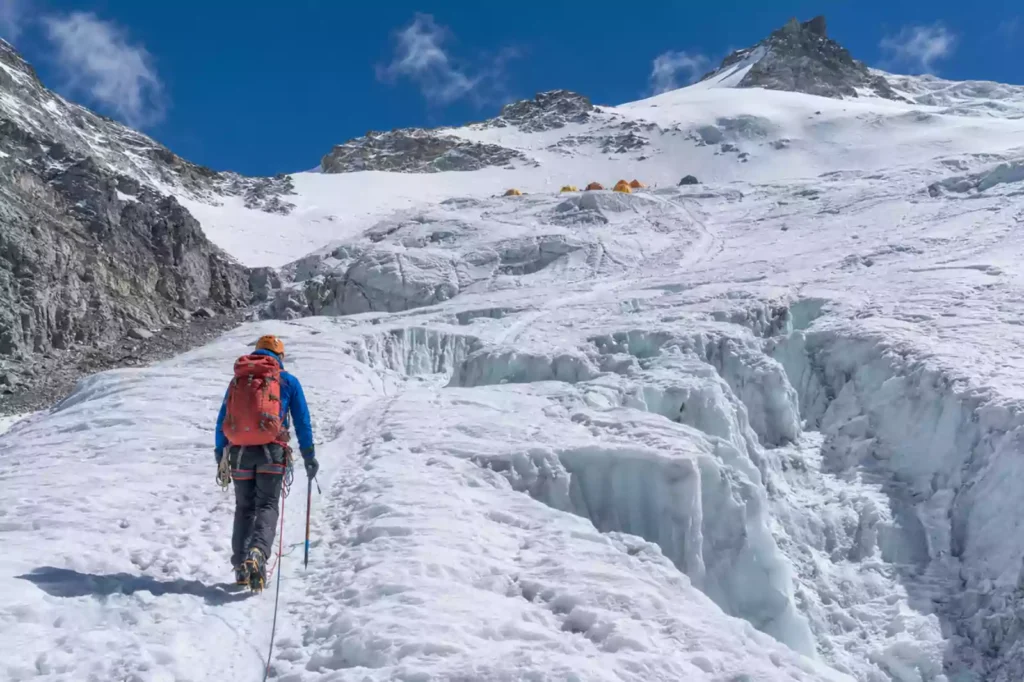
The summit push from High Camp begins before first light, typically between 2:00 and 4:00 AM, to maximise stable weather in the early morning. The final climb to Mera North involves a moderate snow slope with some steeper sections near the top. Crampons and an ice axe are used throughout the summit section. Fixed ropes are not generally required on the standard route, and the technical grade (F, Facile) reflects this: a physically demanding but non-technical ascent by alpine standards.
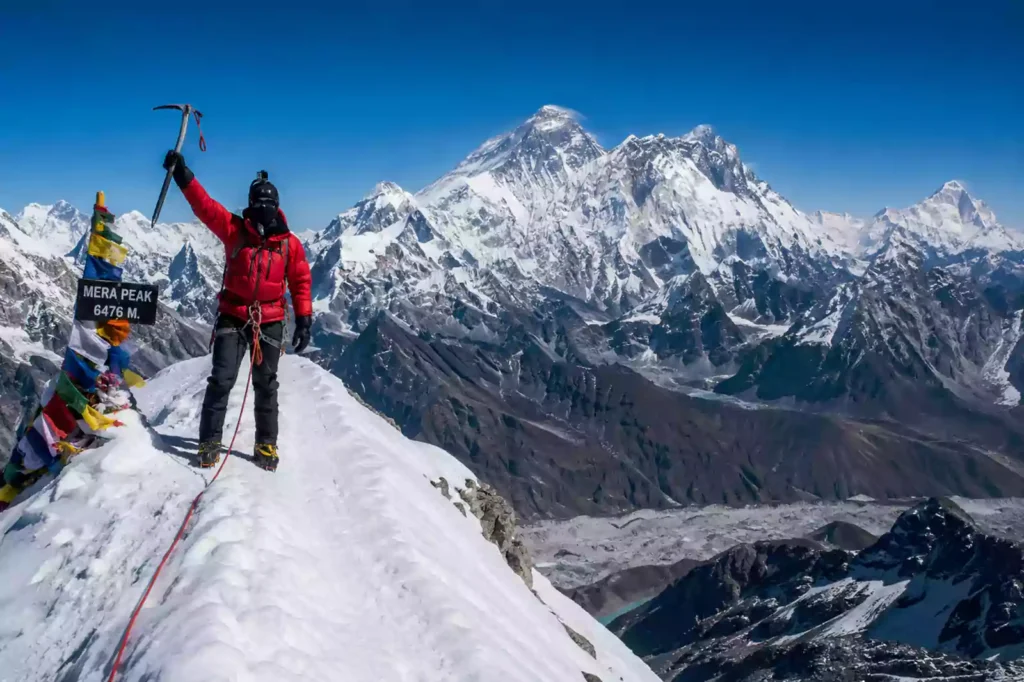
The last 100 metres before the summit ridge involve a steeper snow slope and are the most demanding section of the climb in terms of effort and altitude effect. The summit itself is a broad, relatively flat ridge at 6,476 m, and on a clear day the view encompasses all five of Nepal’s 8,000 m peaks visible from this point: Everest (8,848 m), Lhotse (8,516 m), Makalu (8,463 m), Cho Oyu (8,188 m), and Kanchenjunga (8,586 m), as well as the surrounding Hinku and Khumbu ranges.
After the summit, the entire descent to Khare is completed on the same day, making Day 11 the longest physical effort of the expedition at 8 to 9 hours total.
What’s included in the package
The Nepal Footprint Holiday Mera Peak Climbing package at US$2,500 per person (listed from US$2,600) is all-inclusive and covers:
- Airport transfers and Kathmandu hotel on BB plan
- Kathmandu sightseeing with guide
- Domestic airfare: Kathmandu to Lukla and back
- All meals and accommodation during the full 16-day itinerary
- All climbing permits and park entry fees
- Highly experienced English-speaking climbing guide and Sherpa support
- Porter for personal gear (standard allocation)
- Staff food, wages, clothing, and insurance
- Two nights in tented camp at Mera Peak Base Camp with mattresses and catering
- Group climbing rope and equipment support
- Welcome and farewell dinners in Kathmandu
Not included: Nepal visa, international flights, personal gear rental (available in Kathmandu or Khare for approximately US$150 to US$250 per person), travel and helicopter rescue insurance (mandatory), personal drinks and bar bills, domestic baggage excess beyond 15 kg per person, guide and porter tips.
Permits required for Mera Peak
Mera Peak requires two permits, both handled by the trekking operator:
NMA Trekking Peak Climbing Permit: Issued by the Nepal Mountaineering Association, this is the specific climbing permit for Mera Peak. The fee varies by season. For the main spring and autumn seasons, the current NMA permit fee for Mera Peak is approximately US$250 per person. This is included in the all-inclusive package price.
Sagarmatha National Park Entry Permit: The approach via the Hinku Valley enters Sagarmatha National Park (Makalu Barun National Park in some sections). The applicable entry permit is arranged by the operator and included in the package.
Both permits are included in the Nepal Footprint Holiday package price and do not require separate counter visits by the climber.
Gear: what you need for Mera Peak
The Nepal Footprint Holiday package includes group climbing rope and basic climbing equipment support. Personal gear (either owned or rented) is the climber’s responsibility. Essential items include:
- Mountaineering boots (double or single with crampon compatibility)
- Crampons (12-point, step-in or bail binding)
- Ice axe
- Harness, carabiners, and prussik slings
- Down suit or very warm insulated jacket (summit temperatures can reach -20°C or lower)
- Warm gloves and liner gloves
- Balaclava and insulated hat
- Sun goggles and glacier sunglasses
- Gaiters
- Trekking poles
- Sleeping bag rated to at least -15°C to -20°C
Gear rental in Kathmandu (Thamel equipment shops) or at Khare is available for most items at approximately US$150 to US$250 per person for the full kit. Renting rather than buying is a practical choice for first-time Himalayan climbers who are not yet committed to a full personal kit.
A dedicated guide for peak climbing gear requirements is available on the NFH site and covers the recommended equipment list for all trekking peaks in detail.
Altitude and acclimatisation on Mera Peak
The Mera Peak itinerary is better acclimatised than many climbers expect from a 16-day programme. The Hinku Valley approach gains and loses altitude across multiple passes, giving the body a natural staggered exposure before reaching the high altitude stages. The two formal rest days at Thangnak (4,100 m) and Khare (4,415 m) are the most critical acclimatisation stages.
The biggest altitude jump on the itinerary is from Khare (4,415 m) to High Camp (5,465 m) on Day 10, a gain of 1,050 m in a single day. Trekkers should take this day slowly, monitor symptoms carefully, and be prepared to stop or descend if AMS symptoms appear.
Above 5,000 m, the standard altitude risk rules apply: headache, fatigue, and mild nausea are common and manageable. Loss of coordination, confusion, severe headache unresponsive to painkillers, or breathing difficulty at rest are signals to descend immediately. The climbing Sherpa carries a pulse oximeter and first-aid kit and makes ascent and descent decisions alongside the guide. For a full breakdown of altitude illness symptoms and the day-by-day risk profile on Himalayan climbs, our altitude sickness guide covers each condition in detail.
Best time to climb Mera Peak
Spring (March to May): The most popular season, with settled weather and clear summit views. April is statistically the most reliable month for summit success. The Hinku Valley rhododendron forest is in full bloom through March and April. Longer daylight hours support the summit day. Pre-monsoon cloud builds from late May.
Autumn (September to November): Post-monsoon clarity makes October the peak month for the sharpest summit views. Trails are dry and well-defined after the monsoon. Mid-September through early November offers the best combination of clear skies and manageable temperatures at high camp. By late November, summit temperatures at 6,476 m become significantly colder.
Winter (December to February): Possible for experienced cold-weather climbers but temperatures at High Camp and the summit can drop well below -25°C. Not recommended for a first Himalayan summit.
Monsoon (June to August): Unlike Mustang, the Hinku Valley receives full monsoon precipitation. Trails are slippery, leech-infested at lower altitude, and views at altitude are frequently obscured. Not recommended.
How Mera Peak compares to other first Himalayan summits
Mera Peak is the highest and the least technically demanding of Nepal’s major trekking peak options, which is what makes it the most common recommendation for first-time high-altitude climbers. A comparison with the two most frequent alternatives:
For climbers who want technical skill development alongside their summit, our Island Peak vs Mera Peak comparison covers both peaks in full, including route character, gear requirements, and which trekker profile fits each.Who want to step up from Mera to a more technical peak on a return trip, Lobuche East Climbing at 6,119 m with fixed ropes and glacier sections is the natural progression. For climbers who want a lower-altitude confidence-builder before committing to 6,000 m, Tent Peak Climbing in the Annapurna region at 5,663 m is the recommended step below.
Official classification, permit fees, and regulations covering all NMA trekking peaks, the Nepal Mountaineering Association is the authoritative source.
Frequently asked questions
Is Mera Peak suitable for first-time climbers?
Yes. Mera Peak is the most recommended first Himalayan summit in Nepal precisely because it combines high altitude (6,476 m) with a non-technical ascent. No prior mountaineering experience is required. The climbing Sherpa provides a full gear and technique briefing before the summit push. The key prerequisite is strong physical fitness and prior trekking experience at 4,000 m or above.
How difficult is the Mera Peak climb?
The Nepal Footprint Holiday package rates it as “Challenging” in difficulty, reflecting the demands of the altitude rather than technical complexity. The climb itself is graded F (Facile) in alpine terminology. The summit day is physically demanding (8 to 9 hours total, starting at 2 to 4 AM), cold, and tiring at altitude, but does not require rope ascending, ice wall climbing, or glacier crevasse navigation skills.
What is the summit success rate for Mera Peak?
Nepal Footprint Holiday records a 99.9 percent summit rate for Mera Peak expeditions, supported by experienced local Sherpas, proper logistics, and itineraries that do not compress the acclimatisation stages.
Can I hire climbing gear at Khare?
Yes. Basic climbing gear (crampons, ice axe, harness, boots) is available for hire at Khare, the last village before Mera Base Camp. Kathmandu’s Thamel district also has a wide range of rental equipment. Budget approximately US$150 to US$250 per person for a full personal kit rental.
Standing above 6,400 m with five of the world’s fourteen 8,000 m peaks arranged across the horizon is an experience that requires a high-altitude commitment but not a technical mountaineering background. That is what makes Mera Peak the most logical first step for climbers who are ready to go genuinely high. For the full day-by-day itinerary, fixed departure dates, and all-inclusive pricing, see the Mera Peak Climbing package page. Dates fill quickly in spring and autumn. Inquire Now and the team at Nepal Footprint Holiday will confirm availability and walk you through the preparation steps before your first Himalayan summit.
Government of Nepal registered · Kathmandu-based · 10+ years guiding experience