

Sherpa culture and history form the living heart of the Khumbu Valley. When trekkers walk through Namche Bazaar, pass mani walls carved with sacred mantras, or sit in a teahouse listening to their guide explain why Mount Everest is considered a goddess, they are encountering a culture that has shaped this landscape for over five centuries. Furthermore, understanding Sherpa history before you trek through the Khumbu transforms the entire experience into something far more meaningful than a physical adventure alone.
What Are the Sherpa People?
The word “Sherpa” is Tibetan for “people from the east,” derived from “Shar” meaning east and “Pa” meaning people. It is a direct reference to their origins in the Kham region of eastern Tibet.
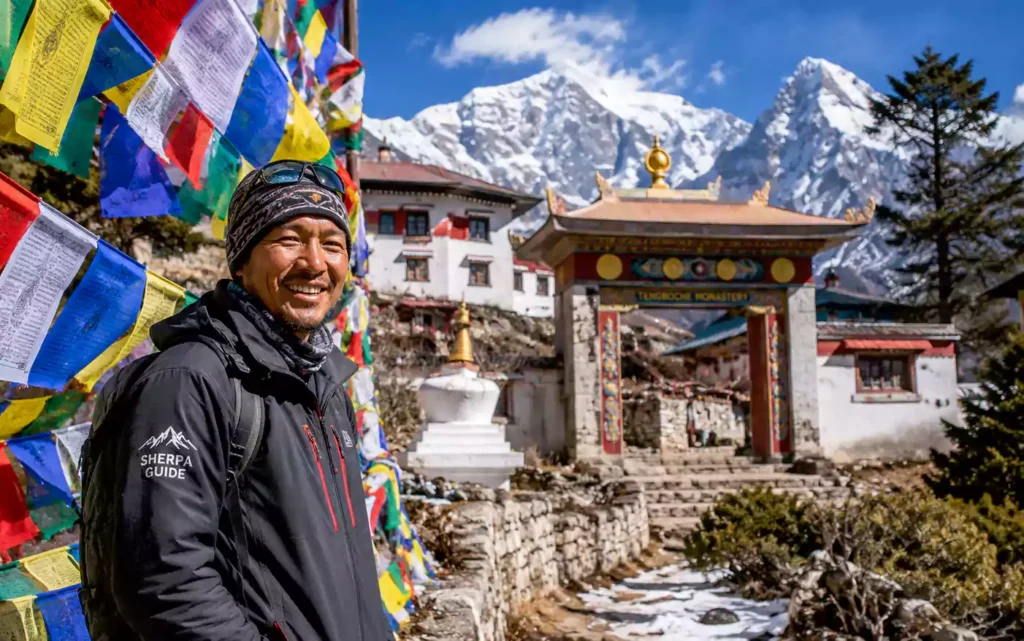
Sherpas migrated south and settled in Nepal’s Khumbu region during the 15th and 16th centuries. They chose high-altitude valleys between 3,000 and 5,000 metres, elevations where very few other communities could establish permanent settlement. As a result, they developed a deep connection with the mountain environment that defines Sherpa identity to this day.
Before mountaineering brought global attention to the region, Sherpas were primarily yak herders and trans-Himalayan traders. They carried salt, wool, and grain across high mountain passes connecting Tibet and Nepal’s lower valleys. This lifestyle built the physical endurance and altitude adaptation that would later make Sherpas legendary in the world of high-altitude climbing.
Today, approximately 150,000 Sherpas live across Nepal. The largest concentration remains in the Solu-Khumbu district, though notable communities also exist in Kathmandu, Darjeeling, and across the Himalayan foothills.
Religion and Spiritual Life
Sherpa culture and history cannot be understood without understanding Tibetan Buddhism. The Sherpa community follows the Nyingmapa sect of Vajrayana Buddhism, the oldest school of Tibetan Buddhism, introduced to the region by the Indian saint Guru Rinpoche (Padmasambhava).
For Sherpas, mountains are not merely landforms. They are sentient beings. Mount Everest is known as Chomolungma, the “Mother Goddess of the World.” Lhotse, Makalu, and Cho Oyu are similarly regarded as protector deities of the region. Consequently, every mountaineering expedition departing from Base Camp begins with a puja ceremony, a Buddhist blessing ritual seeking the mountain deity’s permission to climb.
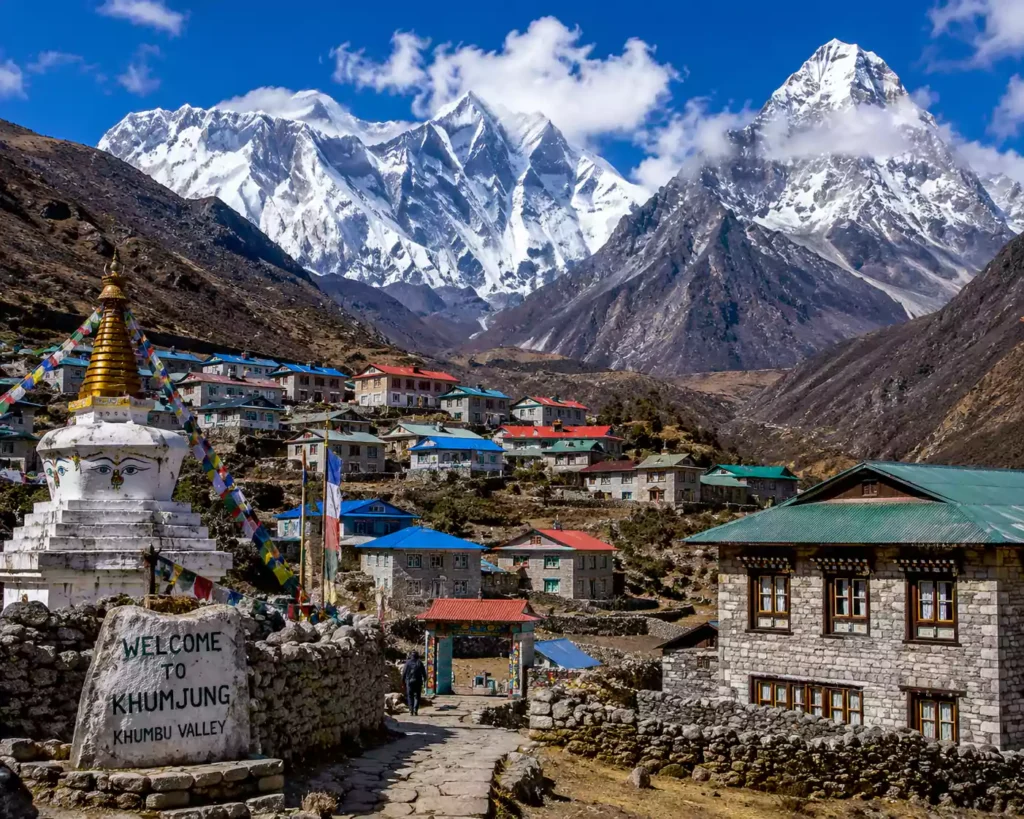
The Khumbu trail is a deeply spiritual place. Prayer flags stretch across every ridgeline, sending wind-borne blessings into the valley. Stone mani walls carved with the sacred mantra Om Mani Padme Hum line every path. Chortens guard important high passes and crossroads. Moreover, monasteries including Tengboche, Pangboche, and Thame remain active spiritual centres for their communities throughout the year.
Khumbu Festivals
Sherpa festivals offer the most vivid window into Sherpa culture and history. Trekkers who plan their visit to the Khumbu correctly can witness celebrations that have endured for hundreds of years.
Losar marks the Sherpa and Tibetan New Year, celebrated in late January or February according to the Tibetan lunar calendar. Families clean their homes to clear negative energy, gather to cook, and pray at their local monastery. It is a family-focused celebration that gives trekkers an intimate glimpse into Sherpa community life.
Dumje is celebrated in June and July across villages, including Namche Bazaar, Pangboche, and Khumjung. It commemorates the birth of Guru Rinpoche and aims to ward off the community’s ill fortune while promoting prosperity and good health. Ritual dances, communal prayer, and several days of village-wide feasting are all part of the celebration.
Mani Rimdu is the most internationally recognised Sherpa festival. The full ceremony lasts 19 days, concluding with three days of public celebration at Tengboche Monastery at 3,867 metres. Monks perform sacred masked Chham dances alongside fire offerings, and the abbot distributes blessed pills to the assembled community. The 2026 public festivities run from 24 to 26 October. Therefore, trekkers on the Everest Base Camp Trek during this period have the opportunity to witness one of the finest cultural events in the entire Himalayas.
Food, Daily Life, and Architecture
Traditional Sherpa homes are built from stone with flat roofs and small windows designed to conserve heat at altitude. The ground floor typically houses livestock during winter, while the upper levels contain the family living space and a dedicated prayer room with butter lamps and Thangka paintings.
Sherpa food is hearty and specifically adapted to high-altitude survival. Tsampa, roasted barley mixed with butter tea, is a daily staple that provides warmth and energy in cold conditions. Dal Bhat, a nutritious meal of lentils, rice, and vegetables, is eaten twice a day by most families. During festivals and family visits, Sherpas also share Chang, a locally brewed barley drink, and Tongba, a warm millet-based beverage served in a wooden vessel.
Sherpa society is built on hospitality and generosity. Sherpas do not hunt or harm animals, a practice rooted in Buddhist values that has been central to their community since it was first established. Offering food and tea to a guest is considered a fundamental expression of good character across all Sherpa communities.
Sherpas and Mountaineering
When Tenzing Norgay Sherpa and Sir Edmund Hillary made the first ascent of Everest on 29 May 1953, the world’s attention turned to the Sherpa people. However, Sherpas had already been successful mountaineers long before 1953, guiding and supporting expeditions across the Himalayas for decades.
Their bodies have adapted to life above 3,500 metres over generations, developing larger lung capacity and the ability to produce more red blood cells at altitude. Furthermore, their intimate knowledge of mountain weather patterns, route conditions, and high-altitude risk makes them irreplaceable partners on any serious expedition.
Several Sherpas have achieved legendary status in mountaineering history. Apa Sherpa and Phurba Tashi each summited Everest 21 times. Kami Rita Sherpa currently holds the record with 29 summits as of 2026. These achievements reflect a generational relationship with the mountains that is inseparable from Sherpa cultural identity.
Many of our guides at Nepal Footprint Holiday come from Khumbu families with lifelong experience organising treks and climbs. Trekking with us means walking alongside that tradition directly.
Experiencing Sherpa Culture on the Trail
The best way to experience Sherpa culture and history is to walk through the Khumbu Valley itself. Our Everest Base Camp Trek passes through Namche Bazaar, Tengboche, and Pangboche, the three most culturally significant Sherpa communities in the eastern Khumbu. Additionally, the Gokyo Lake Trek takes you through the quieter western Khumbu villages where traditional Sherpa life continues with less tourist influence.
For deeper cultural immersion beyond the Khumbu, the Tsum Valley Trek leads through one of the most isolated Tibetan Buddhist communities in Nepal. The Upper Mustang Trek takes you into a former Tibetan kingdom where ancient monastery traditions remain remarkably intact. For experienced trekkers, the Everest High Passes Trek passes through remote Khumbu communities rarely seen on standard itineraries.
All trekkers entering the Khumbu require the Sagarmatha National Park Entry Permit and the Khumbu Pasang Lhamu Rural Municipality Permit. Our Nepal trekking permits guide covers current fees and how to obtain each one. Nepal’s 2025 mandatory guide regulation also requires all trekkers on major routes to travel with a licensed guide. The Nepal Tourism Board provides full regulatory guidance at tourism.gov.np.
Final Thoughts on Sherpa Culture and History
Sherpa culture and history give the Khumbu Valley its soul. Every prayer flag, every monastery, every shared cup of butter tea on the trail carries a story that stretches back five centuries. In conclusion, understanding that story before you arrive is what separates a walk through the mountains from a genuine encounter with one of the world’s most extraordinary living cultures.
Walk through Sherpa country with guides who know it from the inside. Nepal Footprint Holiday are local experts based in Kathmandu.