

The Jomsom Muktinath Trek is a moderate 7 to 10-day journey from Pokhara through the Kali Gandaki valley to the sacred Muktinath Temple at 3,800m in Nepal’s Mustang district.
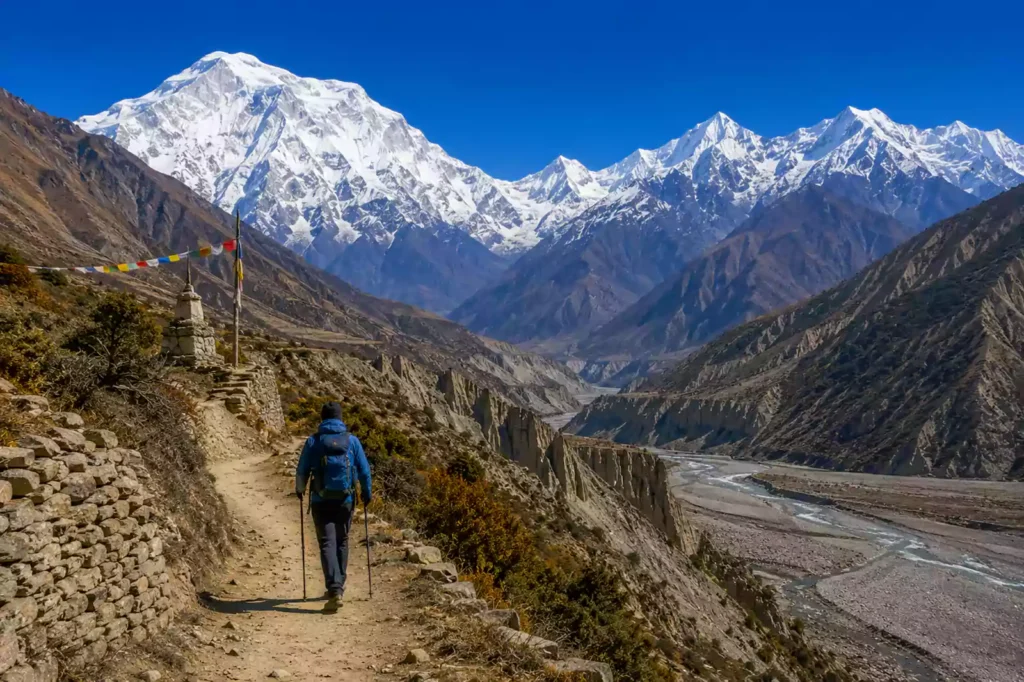
The Jomsom Muktinath Trek is one of the most culturally rich and scenically diverse treks in the Annapurna region. It follows the old Kali Gandaki Valley north to Muktinath — a sacred pilgrimage site revered by Hindus and Buddhists. Moreover, the journey crosses a dramatic climatic shift — from lush green valleys to the dry Tibetan-influenced Mustang plateau.
We guide trekkers on this trail every season. Therefore, this guide provides real trail conditions, permit requirements, daily costs, and cultural detail from years of operating this route.
What Is the Jomsom Muktinath Trek?
The Jomsom Muktinath Trek is a moderate route through the Kali Gandaki valley from Nayapul or Beni to the Muktinath Temple at 3,800m. It passes through Tatopani, Ghasa, Marpha, and Jomsom before reaching Muktinath — one of the 108 Vishnu sacred places in Hinduism.
Because the trail follows an old salt trade route, each village has its own culture: Magar and Gurung below, Tibetan-influenced communities near Muktinath.
Jomsom Muktinath Trek at a Glance
Why Do the Jomsom Muktinath Trek in 2026?
The Jomsom Muktinath Trek offers genuine cultural depth and outstanding scenery without Annapurna Circuit crowd levels.
The Kali Gandaki runs between Dhaulagiri (8,167m) and Annapurna I (8,091m) — consequently one of the most spectacular corridors on any moderate Nepal trek. Furthermore, the afternoon wind has carved the landscape into desert formations and canyon walls that feel more Tibetan than Nepali.
More than 100,000 pilgrims visit Muktinath each year. However, the trail approaching from below remains less crowded than other major pilgrimage routes. Additionally, the Thakali villages of Marpha and Tukuche — with apple orchards and whitewashed stone houses — are among the most photogenic in the Himalayas.
Vibe Check
- Ancient salt trade route atmosphere
- Dhaulagiri and Annapurna framing every valley
- Thakali apple orchards and village hospitality
- Sacred fire and water at Muktinath Temple
- Wind-sculpted desert canyons above Kagbeni
📍
Book your Jomsom Muktinath Trek with Nepal Footprint Holiday, Government of Nepal registered and based in Kathmandu.
What Is the Jomsom Muktinath Trek Route Like?
Most treks begin with a drive from Pokhara to Nayapul or Beni, then head north along the Kali Gandaki through a landscape that changes dramatically each day.
The lower valley flows through Tatopani, then into the tight gorge at Ghasa before opening onto the windswept Mustang plateau above Kalopani. The shift from verdant riverbank to arid desert environment is clearly visible between Ghasa and Marpha.
Marpha is the most popular Thakali village on the trail and a natural rest day stop. Travelers heading north into Upper Mustang often extend with our Mustang Overland Tour. The orchards yield apple pie, dried chips, and apple rakshi that our guides always recommend. Marpha also sits in the rain shadow, so even monsoon visitors enjoy clear afternoons.
Jomsom is the Mustang capital and the last major town before the dry upper valley. From Jomsom, the trail climbs through medieval Kagbeni at the river confluence to the Muktinath Valley. The final approach crosses open hillside with Thorong La and the Annapurna massif to the east.
Route Highlights
For the full day-by-day breakdown, accommodation details, and 2026 package pricing, visit our full itinerary and pricing page.
What Is Muktinath Temple and Why Is It Significant?
The spiritual heart of the Jomsom Muktinath Trek is Muktinath Temple, located at 3,800m below Thorong La — one of the most sacred sites in Nepal for both Hindu and Buddhist pilgrims.
For Hindus, Muktinath is one of 108 Vishnu sacred shrines from Vaishnava scripture. The complex includes 108 water spouts, an eternal flame, and the main Vishnu shrine — all sacred for granting moksha. Although altitude is demanding, the site draws devotees from India, Nepal, and beyond. Those extending to Muktinath often add the Annapurna Base Camp Trek as a connecting route.
For Tibetan Buddhists, Muktinath — known as Chumig Gyatsa — is one of 24 Tantric sacred places. As a result, Buddhist pilgrims from Tibet, Nepal, and Bhutan come alongside Hindu devotees. In short, no moderate Nepal trek has another site with this dual sacred status.
What Permits Do You Need for the Jomsom Muktinath Trek?
The trek requires two standard permits, both arranged in Pokhara or Kathmandu before departure. Nepal’s 2025 licensed guide regulation also applies — all trekkers must travel with a TAAN-licensed guide.
For current official permit fees, visit the Nepal Tourism Board website. Our Nepal trekking permit guide covers all 2025 costs for Annapurna region routes.
What Is the Cost of the Jomsom Muktinath Trek?
The cost of the Jomsom Muktinath Trek is USD 700 to USD 1,400 per person, depending on group size and accommodation standard. Booking directly with a local operator saves 20 to 30 percent versus international agencies.
The return flight from Jomsom saves 3 to 4 days of walking and offers aerial mountain views.
How Difficult Is the Jomsom Muktinath Trek?
The Jomsom Muktinath Trek is moderate in difficulty. Daily walking ranges from 4 to 6 hours on well-marked trails. The maximum altitude of 3,800m is attainable for most reasonably fit travelers without prior high-altitude experience.
However, altitude sickness is possible above 3,000m. The afternoon winds above Jomsom reach 40 to 60 km/h, demanding even for experienced trekkers. Specifically, we always schedule Kagbeni to Muktinath for early morning to avoid the worst winds.
Our Nepal trek difficulty grading guide helps you compare levels before booking. It sits below the Annapurna Circuit Trek in technical demand but above the Poon Hill Trek in duration and altitude.
What Is the Best Season for the Jomsom Muktinath Trek?
The best seasons are spring (March to May) and autumn (September to November). Both offer reliable weather, clear mountain views, and consistent trail conditions.
Spring is particularly colorful — rhododendron bloom covers the lower valley forests in March and April. Furthermore, mountain views are exceptionally clear before pre-monsoon haze builds in May.
Autumn delivers the clearest post-monsoon skies and the best visibility at Muktinath. October is the most popular month — conditions are superb. Many trekkers warm up with the Ghorepani Poon Hill Trek before committing to the longer Jomsom valley approach.
Additionally, the upper valley stays dry despite the monsoon due to the Mustang rain shadow. Trekkers going further north can explore the Upper Mustang Trek for the full restricted-zone experience.
FAQ Schema: Jomsom Muktinath Trek
Q: How long is the Jomsom Muktinath Trek? The Jomsom Muktinath Trek takes 7 to 10 days depending on the starting point and pace. The standard route begins in Nayapul or Beni and reaches Muktinath at 3,800m on Day 7 or 8. Many fly back from Jomsom to Pokhara to save 3 to 4 days.
Q: Is the Jomsom Muktinath Trek suitable for beginners? Yes, with reasonable fitness. The route is moderate with a maximum of 3,800m — manageable without prior high-altitude experience. Daily walking stages of 4 to 6 hours on well-marked trails make it accessible for first-time trekkers. Nevertheless, 4 to 6 weeks of aerobic fitness training and acclimatization awareness above 3,000m are recommended.
Q: Can I fly directly to Jomsom and trek to Muktinath? Yes. Flying from Pokhara to Jomsom takes 20 minutes and places trekkers directly at 2,720m. The walk to Muktinath via Kagbeni takes 2 days. This is popular for pilgrims and travelers with limited time. However, acclimatization matters — flying to Jomsom and immediately climbing to Muktinath risks altitude sickness.
Government of Nepal registered · Kathmandu-based · 10+ years guiding experience
The Valley the Trade Winds Built
The Kali Gandaki valley has been a trade route for more than 1,000 years. Salt came south from Tibet. Grain was transported north from the lowlands. The exchange built these villages — and each stone wall and prayer flag still carries traces of it.
Today, the trade has largely vanished. However, what remains is the landscape it created: the deepest river gorge on earth, desert plateau villages, and a sacred temple at 3,800m where pilgrims have come for centuries.
In conclusion, if you want mountain views, cultural depth, and spiritual significance in one route, the Jomsom Muktinath Trek is a must. Contact our Kathmandu team and we will take care of all the arrangements.