

The Thorong La Pass crossing guide covers a 8 to 10-hour summit day starting at 4:00 AM from Thorong High Camp at 4,925 m, ascending 491 m to the pass at 5,416 m, and descending 1,600 m to Muktinath — the hardest and most rewarding day on the Annapurna Circuit.
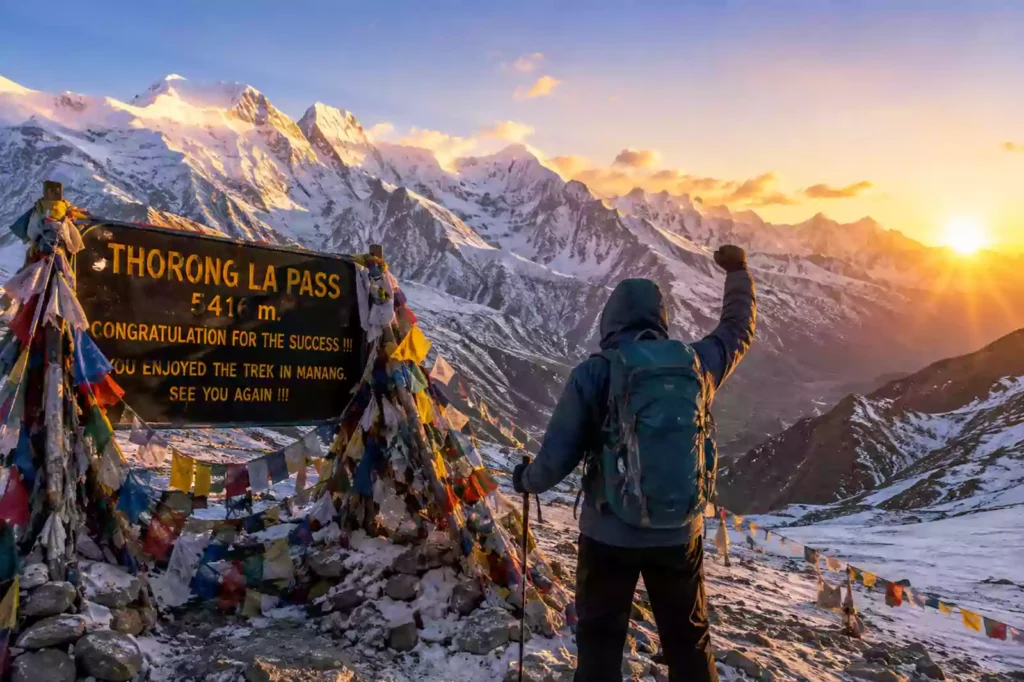
The Thorong La Pass crossing is the defining moment of the Annapurna Circuit Trek. At 5,416 m (17,769 ft), it is one of the highest walkable passes in the world. No ropes or technical climbing are required. However, the altitude, the cold, and the 8 to 10 hours of sustained effort make this one of the most demanding days in Himalayan trekking.
Our guides have crossed Thorong La in every season as part of our Annapurna trekking programme. We know exactly what each hour of that crossing feels like. This guide gives you the timeline, the tips, and the real on-the-ground knowledge to cross it safely and confidently.
What Is Thorong La Pass?
Thorong La Pass sits at 5,416 m in the Annapurna Conservation Area. It connects Manang valley on the east with the sacred temple town of Muktinath on the west. Every year, thousands of trekkers cross it as the high point of the Annapurna Circuit.
The crossing is not technical. However, at the summit you breathe roughly 50% of the oxygen available at sea level. Every step feels effortful. The challenge is altitude and endurance, not climbing skill. Furthermore, there are no villages or medical facilities between Thorong Phedi and Muktinath. That makes preparation and a licensed guide non-negotiable.
How Long Does the Thorong La Pass Crossing Take?
Most trekkers take 8 to 10 hours from Thorong Phedi to Muktinath. The ascent from Phedi to the summit is 4 to 5 hours. From High Camp, it is 2.5 to 3 hours to the summit. Finally, the descent from the pass to Muktinath takes 3 to 4 hours.
The Hour-by-Hour Thorong La Pass Crossing Schedule
3:00 AM — Wake Up at High Camp
Rise at 3:00 AM. Eat a warm, light breakfast, porridge, toast, or eggs. Drink at least 500 ml of warm water or tea. Check that your daypack has everything you need within reach. Do not rush. Move carefully in the dark and cold.
Cold mornings at High Camp reach -10°C to -15°C. Consequently, dress in full layers before stepping outside. Your down jacket goes on immediately, not in your pack.
4:00 AM — Depart High Camp
Proceed on the journey to the pass by 4:00 AM to avoid heavy winds and avalanche risk in the afternoon. This is the single most important timing rule of the crossing. Our guides enforce a 4:00 AM departure on every trip. Trekkers who start late face deteriorating conditions on the descent.
The first section climbs steeply from High Camp through dark, rocky switchbacks. Notably, your headlamp is essential. The ground can be icy. Therefore, move slowly and steadily. Additionally, the altitude here already exceeds 5,000 m, so breathe deeply and pace yourself from the very first step.
5:00 AM — First Hour on the Ascent
By 5:00 AM you are well above High Camp. Also, the terrain opens onto a wide, windswept ridge. The sky begins to lighten in the east. On clear days, Annapurna II (7,937 m) and Gangapurna (7,455 m) appear above the horizon in the pre-dawn glow.
In fact, this hour is often the coldest point of the crossing. Wind chill above 5,100 m can push the effective temperature to -20°C. Therefore, keep your balaclava on and your jacket fully zipped. Stop only briefly for water and snacks. Standing still in the wind drains body heat fast.
6:00 AM — The Steep Push
By 6:00 AM most trekkers enter the steepest section of the ascent. The trail narrows, and the gradient increases significantly. Consequently, take three to four breaths per step if needed. There is no shame in moving slowly, our guides always say that a slow trekker who reaches the top is more successful than a fast one who turns back.
This is also the hour when altitude symptoms most commonly appear. Symptoms to watch for include a throbbing headache, nausea, confusion, or loss of balance. If any of these develop, tell your guide immediately. Specifically, confusion or loss of coordination is a signal to descend at once, regardless of how close the summit appears.
7:00 AM — Approaching the Summit
As you near the pass, the gradient eases slightly. The sky is fully light by now. Wind typically intensifies near the summit ridge. Most trekkers reach the Thorong La summit marker and prayer flags between 7:00 AM and 8:00 AM.
The summit offers one of the great views in Nepal. Dhaulagiri (8,167 m) dominates the western horizon. Annapurna I (8,091 m) rises to the south. Take a photograph, eat a snack, and drink water. Finally, do not linger, afternoon wind builds fast and a long descent still awaits.
8:00 AM — Begin the Descent to Muktinath
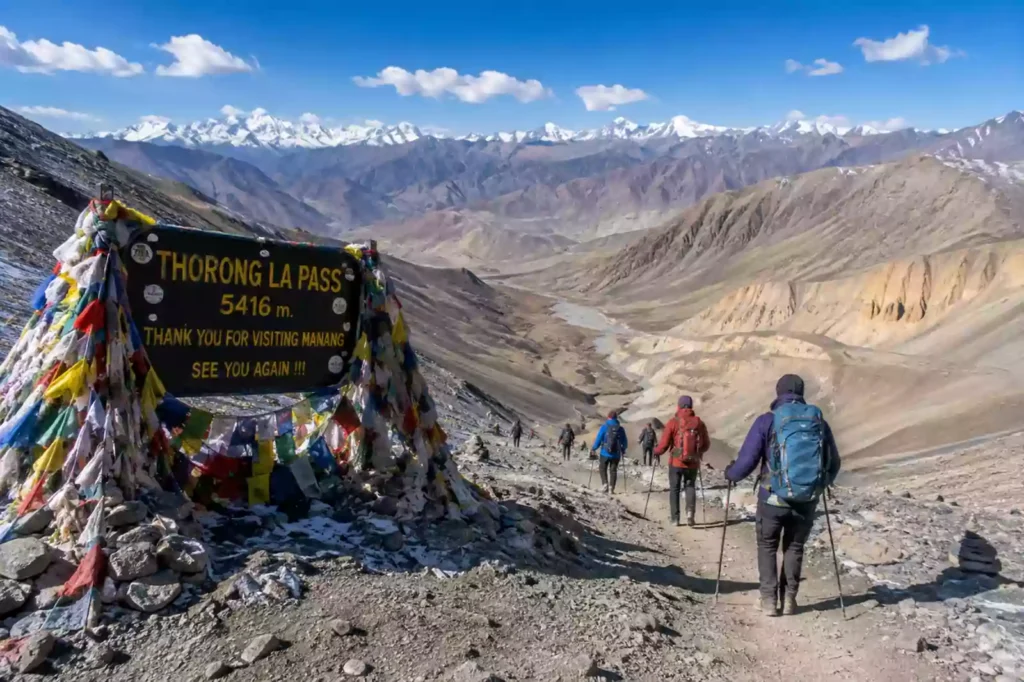
The descent from Thorong La to Muktinath drops 1,600 m over 3 to 4 hours. The upper section is steep, rocky, and loose. Trekking poles are essential here. Take short steps and keep your weight back on the downhill.
As you descend, the landscape transforms rapidly. Alpine moraine gives way to the stark Mustang plateau. Air thickens noticeably with each 100 m of descent. Moreover, energy returns as the altitude drops — many trekkers feel significantly better by 4,500 m than they did at the summit.
11:00 AM to 1:00 PM — Arrive Muktinath
Most trekkers reach Muktinath at 3,800 m between 11:00 AM and 1:00 PM. The Hindu and Buddhist temple complex here is one of the most sacred sites in Nepal, revered by both faiths. Take time to walk through the temple courtyard. After the physical and mental effort of the crossing, the stillness of Muktinath feels genuinely moving.
First, eat a full warm meal immediately on arrival. Dal bhat, soup, or noodles all help the body recover. Furthermore, drink at least one litre of water or electrolyte fluid. Many trekkers underestimate how dehydrated the long crossing leaves them.
Thorong La Pass Crossing: 10 Tips from Our Guides
1. Start at 4:00 AM without exception. Afternoon winds on Thorong La can reach 80 to 100 km/h. Trekkers who start late face conditions that make the descent dangerous. Early start is the single most important rule.
2. Acclimatise properly in Manang. Spend at least two full nights in Manang at 3,519 m before moving to Thorong Phedi. Many trekkers rush this stage. Consequently, they arrive at High Camp already showing altitude symptoms. Take the acclimatisation days seriously.
3. Sleep at High Camp, not Phedi High Camp. At 4,925 m sits 475 m above Thorong Phedi. Sleeping here cuts the summit day ascent significantly. It also means your body starts the crossing already partially acclimatised to the higher elevation.
4. Carry everything you need in your daypack. Even with a porter carrying your main bag, keep the following in your daypack on crossing day: two litres of water, high-energy snacks, headlamp and spare batteries, down jacket, balaclava, gloves, sunscreen, sunglasses, and your permits. Additionally, keep altitude medication (Diamox if prescribed) within easy reach.
5. Dress for -15°C at departure. The summit is cold, windy, and exposed. Dress in thermal base layers, a fleece mid-layer, and a high-loft down jacket at departure. You can remove layers on the descent. You cannot add warmth you do not have.
6. Eat and drink before you feel hungry or thirsty. Appetite disappears above 5,000 m. Thirst signals are also unreliable at altitude. Eat a snack every 45 minutes and drink 200 to 300 ml of water every 30 minutes regardless of how you feel.
7. Walk at a pace you can sustain for 8 hours. The most common mistake on Thorong La is starting too fast. A pace that feels easy at 4,925 m will feel brutal at 5,200 m. Set a slow, rhythmic speed from the first step and hold it.
8. Do not push through warning signs. Severe headache, confusion, vomiting, and loss of coordination are signs to descend immediately. Thorong La has claimed lives. Our guides carry pulse oximeters and make descent decisions without hesitation when symptoms warrant it.
9. Use your trekking poles throughout. Poles reduce knee stress significantly on the 1,600 m descent. They also improve balance on icy morning sections near the summit. We recommend two poles, not one, on crossing day.
10. Know that the descent is harder than it looks. Many trekkers underestimate the descent. After 4 to 5 hours of ascent, the 3 to 4-hour drop to Muktinath on loose, steep terrain is physically taxing. Slow down on the downhill and protect your knees.
What to Carry on Thorong La Pass Crossing Day
- Headlamp: with fresh batteries (departure is in darkness)
- Down jacket: worn from the start, not packed
- Balaclava and warm gloves: wind chill is severe near the summit
- Sunglasses: UV protection essential on snow and ice
- Sunscreen SPF 50+: altitude UV exposure is intense
- Two litres of water: at least one in an insulated bottle to prevent freezing
- High-energy snacks: energy bars, nuts, dried fruit, chocolate
- Trekking poles: two, with snow baskets
- Basic first-aid and Diamox if prescribed by your doctor
- Camera or phone: fully charged and kept warm in an inside pocket
Do You Need a Guide for the Thorong La Pass Crossing?
Yes. As of 2026, a licensed trekking guide is required for the Annapurna Circuit and this is enforced at checkpoints. The guide requirement is especially important for Thorong La: there are no villages or medical facilities between Phedi and Muktinath, and a guide who knows this section can make critical safety decisions about pace, weather, and altitude symptoms.
Under Nepal’s 2025 mandatory guide regulation, introduced by the Nepal Tourism Board and TAAN (Trekking Agencies’ Association of Nepal), all foreign trekkers in the Annapurna Conservation Area must trek with a government-certified guide. Our full trekking permit guide covers the 2026 requirements for the Annapurna Circuit in detail.
What Is the Best Time of Year to Cross Thorong La Pass?
Spring (March to May) and autumn (September to November) offer the most reliable crossing conditions. October is the prime month — clear skies, settled weather, and firm trail conditions on the ascent.
November and March are also excellent. December to February crossings are possible for experienced trekkers but carry real risk of heavy snowfall and pass closure. The monsoon from June to August brings dangerous afternoon storms and is not recommended. Our trekking season guide covers monthly Thorong La conditions in detail.
Is Altitude Sickness a Risk on Thorong La?
Yes. At the altitude of Thorong La at 5,416 m, oxygen is scarce and every step is effortful. Any trekker planning to cross must respect the altitude — ascend slowly, stay hydrated, and watch for AMS symptoms.
Our guides carry pulse oximeters, supplemental oxygen, and a basic medical kit on every Annapurna Circuit departure. We monitor every trekker’s oxygen saturation at High Camp before the crossing begins. Anyone showing SpO2 below 80% at rest does not proceed to the summit. Read our altitude sickness guide before booking.
How to Prepare Your Body for Thorong La
The most important preparation for Thorong La is the acclimatisation you do on the trail in the days before the crossing. Specifically, the schedule looks like this:
- Arrive Manang (3,519 m): Rest 2 full nights minimum
- Day hike to Ice Lake (4,600 m) or Gangapurna Lake: Climbs high, sleeps low — optimal acclimatisation strategy
- Move to Thorong Phedi (4,450 m): One night
- Move to High Camp (4,925 m): One night — crucial step
- Cross Thorong La (5,416 m): Summit day
Those who have followed our Everest Base Camp trek training plan before arriving will find the crossing significantly more manageable. Those who want to read about how other trekkers describe the peak climbing season in Nepal can also use that guide to plan their crossing month. Additionally, our Tilicho Lake Trek page is worth reading for trekkers who want to add an optional acclimatisation side trek near Manang before the crossing. Those wanting to explore the Annapurna region at a lower altitude first can read our guide to the Jomsom Muktinath Trek, which approaches Muktinath from the opposite direction without crossing the pass.
“Thorong La is 10 percent gear, 40 percent fitness, and 50 percent mental strength. The trekkers who struggle most are not the least fit — they are the ones who started too fast or did not acclimatise properly in Manang. The ones who succeed are the ones who respect the mountain from the first step.” — Nepal Footprint Holiday senior guide, Annapurna Circuit specialist with 12 years of Thorong La crossings.
Government of Nepal registered · Kathmandu-based · 10+ years guiding experience