


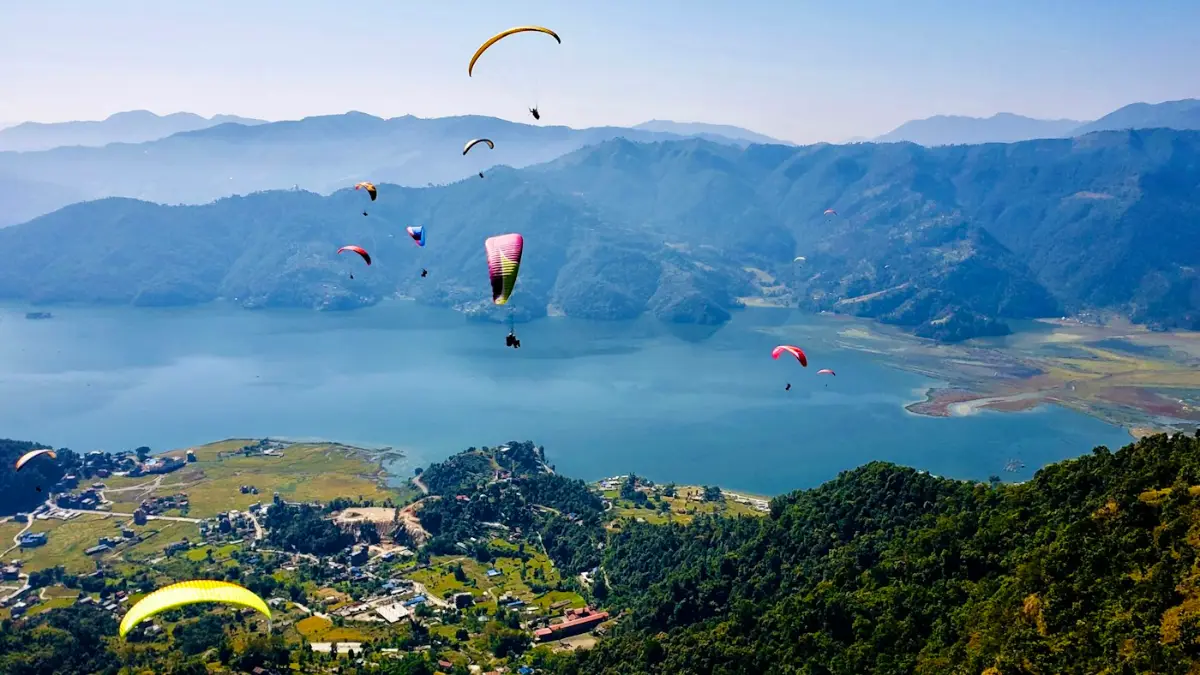
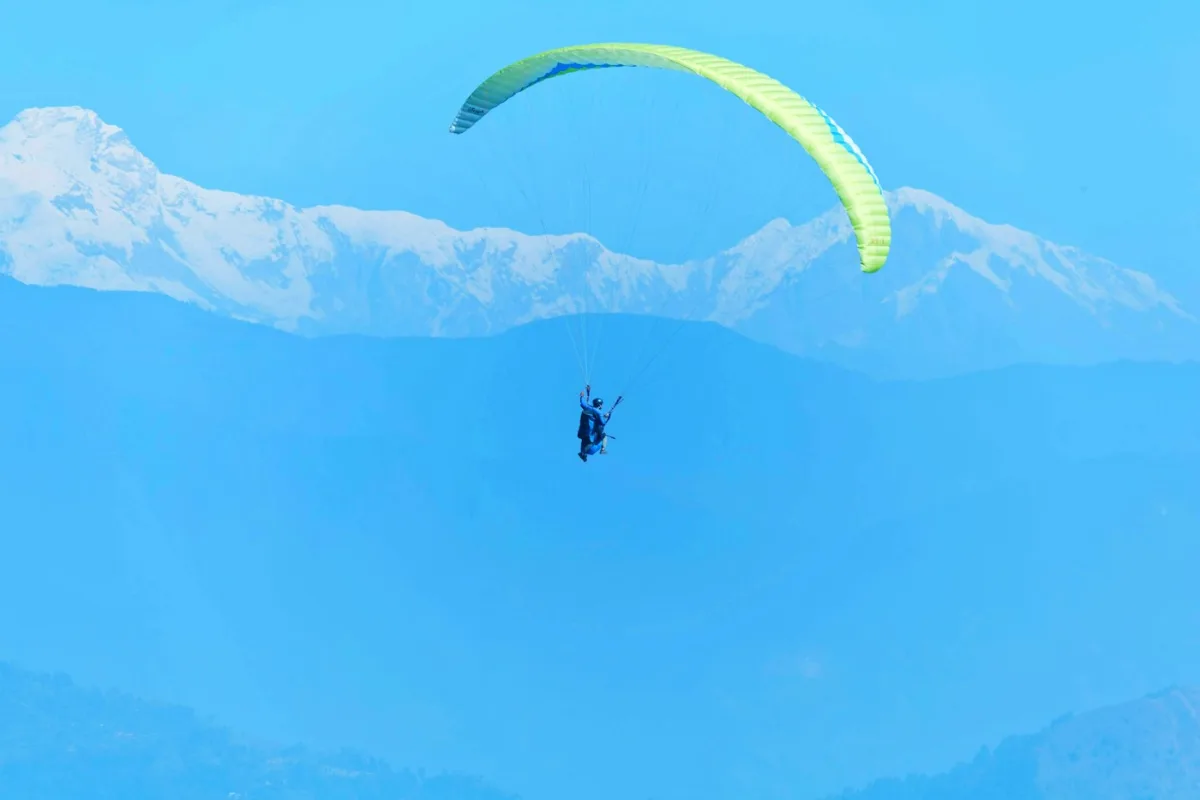
Paragliding in Pokhara is the adventure almost every visitor to Nepal’s lake city ends up asking about. You take three or four quick steps down a grassy slope, the wing fills with air above your head, and the ground simply falls away. A few seconds later you are hanging above Phewa Lake, with Machhapuchhre and the Annapurna range lined up across the horizon. You need no training, no special fitness, and no more than half a day.
We arrange flights for trekkers almost every week of the flying season, usually on the spare day at the end of an Annapurna trek, and the same questions come up each time. How much does it cost? Is it safe? Do flights still land by the lake now that the new airport is open? This guide answers all of them for 2027 bookings, along with the practical details most guides skip.
Paragliding in Pokhara at a Glance
| Type of flight | Tandem, with a licensed pilot flying the wing and you seated in front |
| Main take-off | Sarangkot ridge (about 1,590 m); Toripani and Bahakot are also used |
| Landing | Khapaudi area on the northern shore of Phewa Lake (confirm when you book) |
| Time in the air | 20 to 30 minutes standard; 45 to 60 minutes cross-country |
| Total time | About 3 hours, hotel to hotel |
| Typical price | USD 75 to 100 (roughly NPR 9,000 to 13,000) for a standard tandem |
| Best months | October to November, then March to May |
| Experience needed | None |
Why Pokhara Is One of the World’s Best Places to Paraglide
Plenty of towns offer tandem flights. Very few put this much scenery into a single half-hour. Pokhara sits at around 800 m, and the ridges that wrap around the valley rise to roughly 1,600 m. That gives pilots a generous drop from launch to landing, and the sun-warmed slopes above a large, cool lake create the rising columns of air (thermals) that keep a wing up for far longer than a simple glide would.
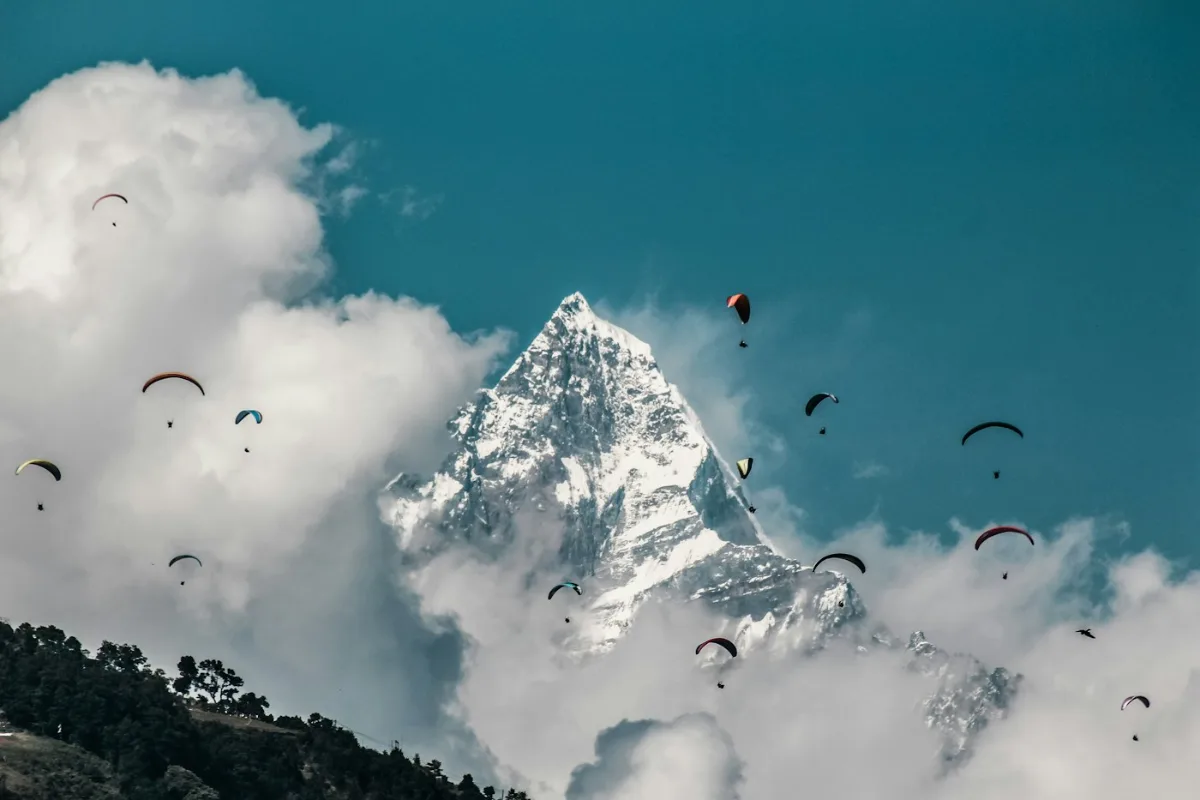
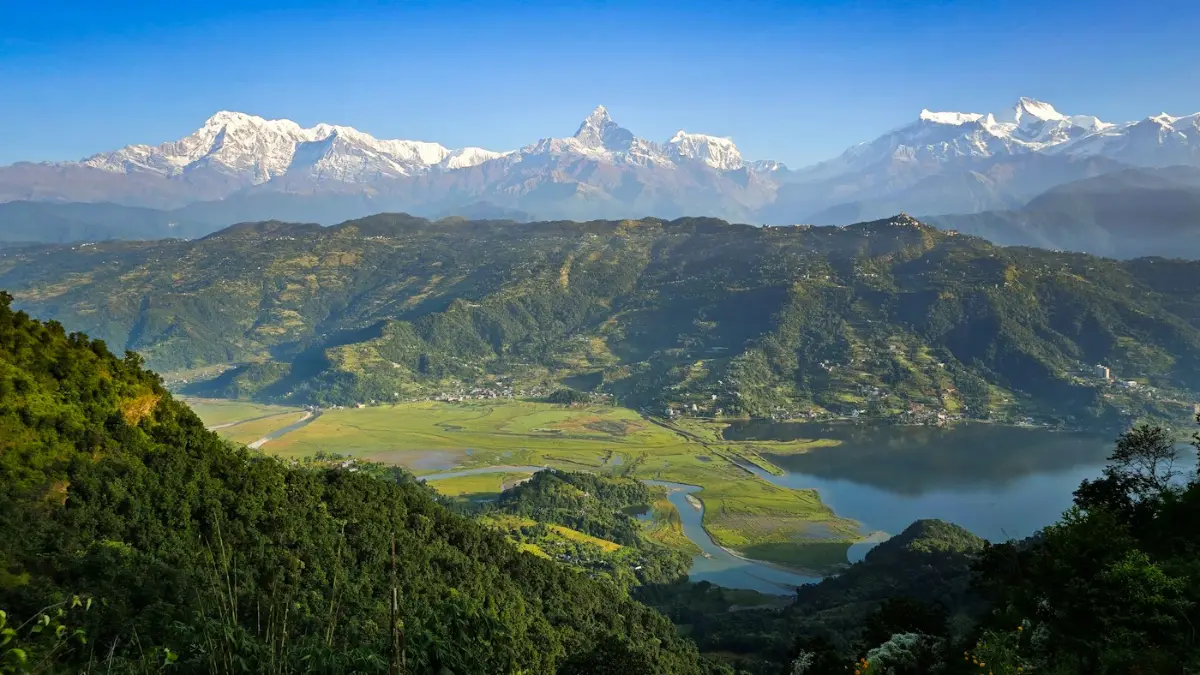
Then there is the view. On a clear day you can see Machhapuchhre (6,993 m), the Annapurna massif and, further west, Dhaulagiri. Few launch sites anywhere put 8,000-metre peaks behind a passenger within 25 minutes of their hotel. Commercial flying started at Sarangkot in the mid-1990s, and by 2024 the valley supported about 60 paragliding companies and close to 400 licensed pilots.
You will not be alone up there, either. Himalayan griffon vultures and steppe eagles use the same thermals, and it is common to share a climbing column of air with a bird with a wingspan close to three metres.
Where Flights Take Off and Land Now
If you read an older blog, you will probably be told to land on the Lakeside promenade at sunrise. That picture changed when Pokhara International Airport opened on 1 January 2023. The airspace over Phewa Lake now sits close to the approach path for commercial flights, so the Civil Aviation Authority of Nepal (CAAN) restricted where and when paragliders could fly.
For a while, flights were pushed west, launching from Mandredhunga and later Toripani, and landing on a riverbank rather than at the lake. Business in the valley dropped sharply during that period. After talks between CAAN and the air sports operators, launches from Sarangkot and landings near the lake shore at Khapaudi came back for most companies, with Toripani and Bahakot kept as alternative take-off points.
Our advice is simple: rules here have changed several times in three years, so ask your operator to confirm the launch and landing site on the day you book. A good company will tell you without hesitation.
How Much Does Paragliding in Pokhara Cost in 2027?
Prices vary by company, by season, and, at some operators, by nationality. These are the ranges we see for flights booked in Pokhara:
| Flight or extra | Duration | Typical price |
|---|---|---|
| Standard tandem | 20 to 30 min | USD 75 to 100 (NPR 9,000 to 13,000) |
| Cross-country tandem | 45 to 60 min | USD 110 to 150 |
| Acrobatic tandem (on request) | 20 to 30 min | USD 100 to 130 |
| Photos and video from the pilot’s camera | Per flight | NPR 1,500 to 3,000 |
| Tip for your pilot (optional) | Per flight | NPR 500 to 1,000 |
A fair quote should include the jeep transfer from your hotel to the launch ridge, the return from the landing field, all equipment including helmet and reserve parachute, the air sports fee, and passenger insurance. When two quotes differ by USD 20 or more, one of those items is usually missing. Smaller agencies along Lakeside often prefer cash, so read our note on how much cash to carry in Nepal before you arrive. If you would rather have it all sorted in advance, our paragliding in Nepal package bundles the flight with transfers and a hotel night in Pokhara.
When Is the Best Time for Paragliding in Pokhara?
Flights operate for most of the year, but the experience changes a lot with the season.
- October to November: The best window. Post-monsoon air is clean, thermals are steady, and the mountains stay visible well into the day. It is also the busiest time, so book a day or two ahead.
- December to February: Clear and calm, but cold at launch and with weaker thermals, so flights can be a little shorter. Morning fog in the valley can delay the first slots.
- March to May: Strong thermals and the longest flights of the year. Haze builds towards May and can soften the mountain views, although rhododendrons on the hills make up for it.
- June to September: Monsoon. Some days still fly between showers, but cancellations are frequent, and cloud often hides the peaks.
For a month-by-month picture of conditions, see our guide to weather and climate in Nepal.
What time of day do flights run?
Flights run inside a CAAN-approved daytime window, which in recent seasons has opened in the late morning and closed by mid-afternoon. That suits the physics anyway: thermals need a few hours of sunshine to build. The catch is that the famous sunrise flight no longer exists. If you want dawn light on the Annapurnas, take a separate early drive or walk up to the Sarangkot viewpoint, then fly later the same day.
What Your Flight Day Actually Looks Like
Most first-timers are nervous about the unknowns, so here is how a typical morning plays out.
Your pickup arrives at the hotel, usually a shared jeep with a couple of other passengers and their pilots. The drive up to the ridge takes 20 to 30 minutes on a steep, winding road. At the top, you will find a row of wings laid out on the grass and pilots watching the wind socks and the birds, because the birds always find the lift first.
Your pilot clips you into a harness, fits your helmet, and gives a short briefing. It really is short: lean forward, keep running when told to, do not sit down until the pilot says so. When the wind is right, you take a few steps, then a few more, and then your feet are pedalling air.
The first minute is the loudest one in your head. After that, the harness feels like a reclined armchair, and you start noticing things: the lake opening out below, paddle boats the size of rice grains, the fishtail summit of Machhapuchhre poking above the cloud. Many pilots will hand you the controls for a minute if you ask. Near the end, you can request a few spiral turns, or politely decline them if your stomach would prefer you did.
Landing is a gentle jog on a flat field. Expect around 3 hours from pickup to drop-off, of which half an hour is the flight itself.
Is Paragliding in Pokhara Safe?
Tandem paragliding in Pokhara is regulated by CAAN, and pilots are licensed through the Nepal Air Sports Association. Considering how many people fly every season, the tandem safety record is good. The real difference in risk lies between operators, not in the activity itself.
Solo flying was suspended for nearly three years after a fatal accident and was only reopened to certified pilots in 2026, with stricter conduct rules and licence penalties for breaking them. For visitors, the practical market remains tandem flights.
Before paying anyone, ask these questions:
- Is my pilot licensed for tandem flights, and roughly how many flying hours do they have?
- Does the price include passenger insurance, and for how much?
- When was the reserve parachute last repacked?
- Which take-off and landing sites are you cleared to use this season?
- What happens to my payment if the weather cancels the flight?
An operator who hesitates over any of these is worth walking away from. There are dozens of offices along Lakeside, and the good ones are happy to answer. For wider travel safety advice, read Is Nepal safe to visit.
Who Can Fly? Weight, Age and Health
Weight matters more than fitness. Most companies accept passengers between about 30 kg and 100 kg, and some can fly heavier passengers on a larger wing if you tell them in advance. There is no national age limit, so operators set their own. Teenagers fly regularly, and some companies take younger children with a parent’s signed consent.
Skip the flight, or speak to a doctor first, if you have a recent back or neck injury, a heart condition, epilepsy, or are pregnant. You will sign a short declaration at the launch site. Mild nerves are normal; a genuine fear of heights is worth thinking about before you pay, because the take-off cannot be paused once you are running.
What to Wear and Bring
- Closed shoes with good grip. Trail runners or light hiking boots are ideal; sandals are not.
- A windproof jacket, even on a warm day. It is noticeably cooler at 2,000 m in moving air.
- Sunglasses with a strap and sunscreen.
- A phone or camera only if it has a secure lanyard. Phones dropped over Phewa Lake are not coming back.
- A light breakfast. Flying on a full stomach, or after a late night in Lakeside, is a mistake people make exactly once.
Paragliding Compared With Other Pokhara Adventures
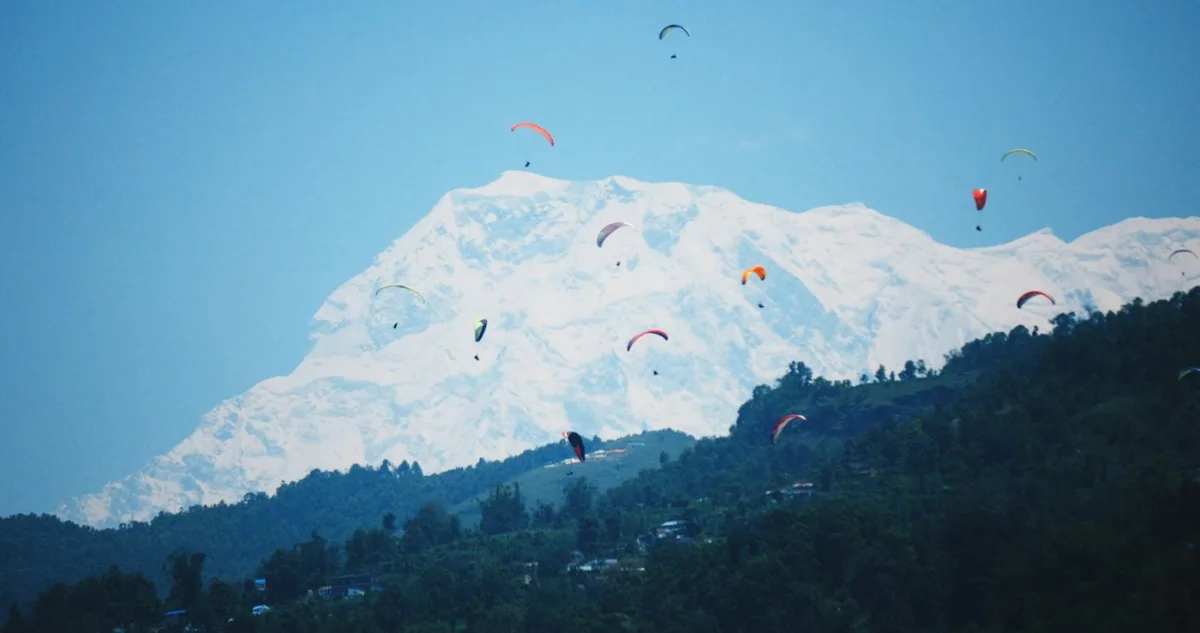
Pokhara is Nepal’s adventure base, and paragliding is only one way to see the valley from above.
- Zip-flying: A fast, short ride from Sarangkot down a steep cable. Pure adrenaline, but over in a couple of minutes. See our zip-flying trip.
- Ultralight flights: Engine-powered and able to fly closer to the mountains, but noisier and pricier per minute.
- Everest mountain flight: A different experience altogether, flying from Kathmandu along the high Himalaya. Read our Everest mountain flight guide.
- White-water rafting: The Seti and Trishuli rivers are close by and pair well with a flying day. Our rafting in Nepal guide covers the best rivers.
If you want to string several of these together, our Nepal adventure holidays guide has ideas for combining them.
How to Fit a Flight Into Your Trek
A tandem flight needs half a day and no recovery time, which makes it ideal for the buffer day that most Annapurna itineraries keep in Pokhara. We usually suggest flying at the end of a trek rather than the start. Your legs are tired, but your schedule is looser, and if the weather cancels the flight, you still have time to try again before heading to Kathmandu or Chitwan National Park.
Treks that start and finish near Pokhara include the short Poon Hill trek, the ridge-top Mardi Himal trek, the quieter Khopra Hill trek, and the classic Annapurna Base Camp trek. Trekkers finishing the Annapurna Circuit also come through Pokhara at the end. There is something satisfying about gliding past the same ridges you have just spent a week or two walking.
Frequently Asked Questions
Do I need any experience to go paragliding in Pokhara?
No. On a tandem flight, the pilot handles the take-off, steering, and landing. You only need to follow a few simple instructions during take-off.
How long is a paragliding flight in Pokhara?
A standard flight lasts 20 to 30 minutes in the air, and a cross-country flight lasts 45 to 60 minutes. Allow about 3 hours in total, including transfers and the briefing.
Can I take my own photos during the flight?
Yes, if your phone or camera is on a secure strap. Most pilots also carry a camera on a selfie pole and sell the photos and video for an extra fee.
What happens if the weather is bad?
Pilots make the final go or no-go call at the launch site. Reputable operators offer a free reschedule or a full refund if your flight is cancelled for weather, but confirm this before paying a deposit.
Can tourists fly solo?
Solo flying reopened in 2026 only for certified, experienced pilots flying within approved zones. If you are not already a qualified pilot, a tandem flight is the way to fly, or you can join a multi-day beginner course with a licensed school.
Is paragliding in Pokhara worth the money?
For most people, yes. For around USD 75 to 100, you get half an hour above one of the most beautiful lake and mountain views in Asia. Many of our guests rate it as the highlight of their trip, ahead of some of the treks.
Ready to Fly Over Pokhara?
Paragliding in Pokhara is easy to arrange, suits almost any traveller, and gives you a view of the Annapurnas that no trail can match. Pick the right season, choose an operator that answers your questions, and keep a spare day in case the weather has other ideas.
If you would like us to book your flight, add it to a trek, or plan a full Nepal itinerary around it, send us an inquiry. Before you travel, check the latest Nepal visa information as well.