

Altitude sickness on the Everest Base Camp trek becomes a meaningful risk from Day 4 onward, once trekkers cross 3,000 m above Namche Bazaar, and reaches its highest danger zone between Days 8 and 11, when the itinerary moves through Dingboche (4,360 m), Lobuche (4,940 m), and Gorak Shep (5,140 m). The most critical altitude sickness prevention strategy for Everest Base Camp is the itinerary itself: a properly staged ascent with built-in acclimatisation days at Namche and Dingboche reduces risk significantly, while a rushed schedule that skips rest days is the single most common cause of serious altitude illness on the EBC trail.
This guide maps the risk day by day against the EBC itinerary, explains the three forms of altitude illness from mild AMS to life-threatening HACE, and sets out the prevention and response protocols that every trekker and their guide should know before leaving Lukla.
What is altitude sickness and why does EBC carry serious risk?
Altitude sickness, also known as Acute Mountain Sickness (AMS), occurs when the body ascends to high elevation faster than it can adapt to reduced atmospheric pressure and lower oxygen availability. The Everest Base Camp trek starts at Lukla (2,860 m), a point already well above the threshold where early AMS symptoms can appear in susceptible individuals, and climbs to Kala Patthar (5,545 m) and EBC itself (5,364 m), where oxygen availability is roughly half that at sea level.
Critically, altitude sickness is not a fitness test. Physical strength, age, and prior mountaineering experience are poor predictors of who will be affected. A highly trained athlete can develop severe AMS while a sedentary first-time trekker acclimatises without issue. The body’s ability to adjust to altitude is largely individual and cannot be conditioned through training alone. This is why the pace of ascent, not the fitness of the trekker, is the primary prevention tool.
The three forms of altitude illness on EBC
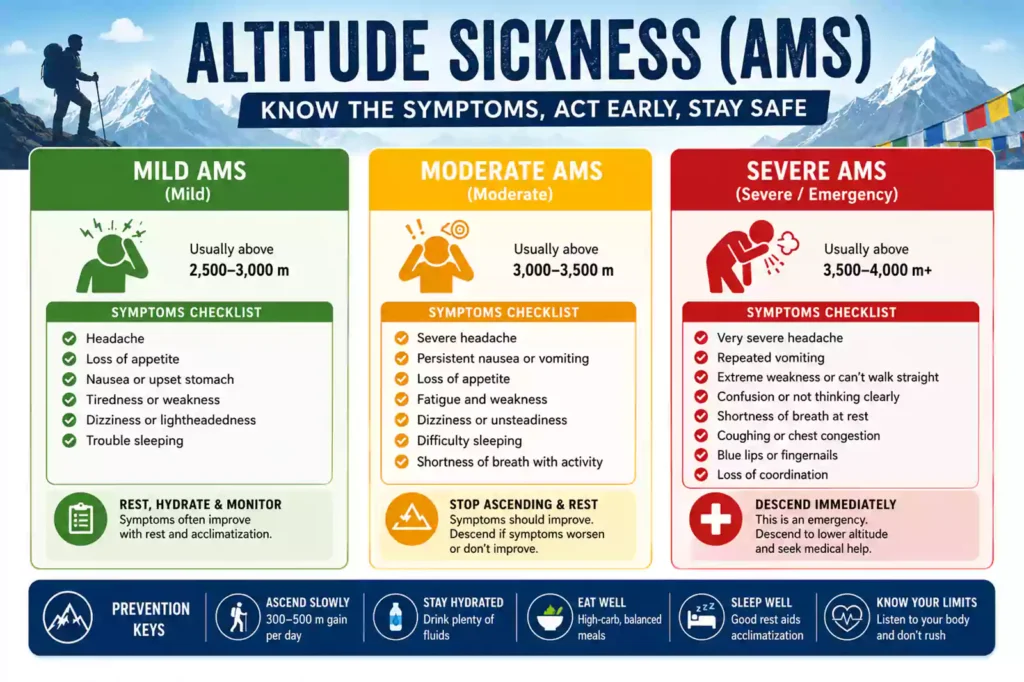
Acute Mountain Sickness (AMS) – mild to moderate: The most common form, presenting as headache, fatigue, loss of appetite, nausea, dizziness, and disturbed sleep. AMS symptoms typically appear within 6–12 hours of reaching a new altitude and often improve with rest, hydration, and stopping further ascent. Most EBC trekkers will experience at least mild AMS above 3,500 m.
High Altitude Cerebral Oedema (HACE) – severe and life-threatening: HACE develops when fluid leaks into brain tissue at altitude, causing dangerous swelling. It is most commonly observed above 3,500 m and represents a medical emergency. Key symptoms include severe, unrelenting headache, loss of coordination (the trekker cannot walk in a straight line), confusion or altered mental state, extreme fatigue, and in advanced stages, hallucinations and loss of consciousness. HACE requires immediate descent and supplemental oxygen if available. There is no safe option to wait and observe.
High Altitude Pulmonary Oedema (HAPE) – severe and life-threatening: HAPE involves fluid accumulation in the lungs, causing progressive breathing difficulty, persistent dry cough, reduced exercise tolerance, and eventually frothy or pink-tinged sputum. HAPE can develop without prior AMS symptoms and can progress rapidly overnight. Like HACE, it demands immediate descent and is the leading cause of altitude-related death among trekkers worldwide.
Day-by-day altitude risk map: EBC itinerary
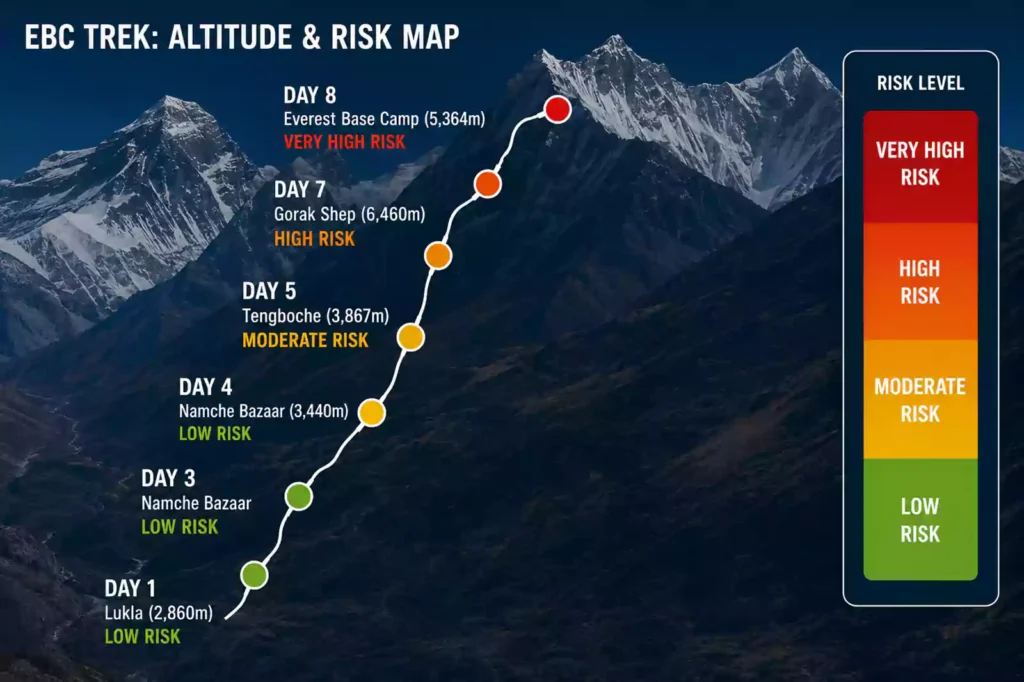
The table below maps each stage of the standard EBC itinerary against sleeping altitude, the AMS risk level for that night, and the key prevention action for the day. Risk levels reflect the combined effect of altitude gained and time spent at elevation, not absolute elevation alone. This is why acclimatisation days carry a lower risk rating despite sleeping at the same altitude as the previous night.
The two most important days on the risk map are Day 3 and Day 6. The Namche acclimatisation day (Day 3) is the first chance the body has to adapt above 3,000 m before ascending further. The Dingboche acclimatisation day (Day 6) is the last opportunity to stabilise before entering the highest and most exposed section of the route above 4,500 m. Skipping either of these rest days in favour of a faster itinerary dramatically increases AMS risk in the upper Khumbu.
Altitude sickness Everest Base Camp prevention: what actually works
Ascend gradually and follow the golden rule
Never increase sleeping altitude by more than 300–500 m per night above 3,000 m. The EBC itinerary is designed around this principle, and departing from it by skipping rest days or combining stages erases the built-in safety margin.
Hydrate consistently
Dehydration accelerates AMS symptoms. Trekkers should aim to drink 3–4 litres of water daily on trek, more than they feel they need, particularly above 4,000 m. Hot drinks, soups, and dal bhat broth all count. Alcohol dehydrates and should be avoided above Namche.
Eat light and high-carbohydrate
Heavy, fatty meals are harder for the body to process at altitude. Carbohydrate-rich foods such as rice, noodles, and dal bhat are better fuel for high-altitude trekking days.
Walk high, sleep low where possible
On rest days at Namche and Dingboche, the standard protocol is to ascend to a higher point during the day and return to the lower sleeping altitude. This stimulates acclimatisation without adding cumulative elevation stress overnight.
Take pulse oximeter readings daily
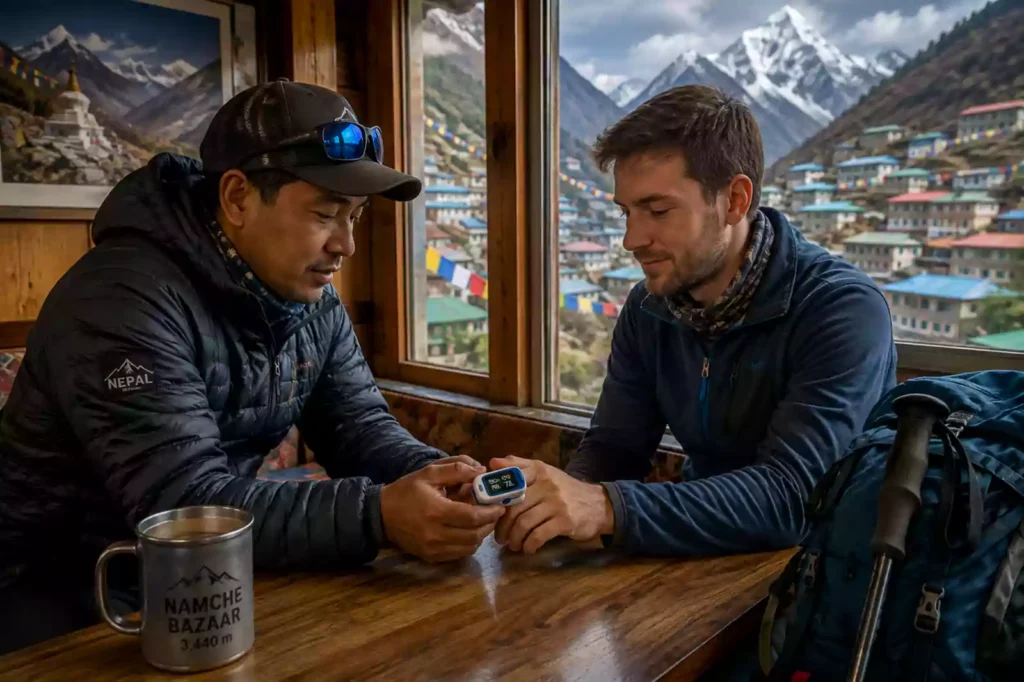
A licensed guide carries a pulse oximeter and takes blood oxygen (SpO₂) readings each morning and evening from Namche upward. An SpO₂ reading below 80% at rest, or a reading that falls significantly overnight and does not recover, is a signal to stop ascending and consult the guide.
Know the Lake Louise Score
The Lake Louise Scoring System is a clinical tool used to assess AMS severity based on symptoms. A guide trained in wilderness first aid uses this to make objective decisions about ascent or descent rather than relying on a trekker’s self-assessment, which is often inaccurate when early confusion or poor judgement is itself a symptom of AMS.
Medications: use only under medical advice
Acetazolamide (Diamox) is a prescription diuretic that can reduce AMS symptoms by stimulating faster breathing. It should only be used under guidance from a doctor familiar with altitude medicine, as it has contraindications and side effects. It is not a substitute for proper acclimatisation and tool that complements a well-staged itinerary, not one that allows the itinerary to be compressed.
Descend immediately if symptoms escalate
No summit view, schedule, or sunk cost justifies continuing upward when a trekker shows signs of HACE or HAPE. The correct response to either is immediate descent of at least 500–1,000 m, and in severe cases, helicopter evacuation from the nearest landing site. Gorak Shep, Lobuche, Pheriche, and Namche all have helicopter evacuation options. Travel insurance with helicopter evacuation cover is non-negotiable on the EBC route.
Warning signs that require immediate action
Any one of the following symptoms on the EBC trail should be treated as a medical emergency requiring immediate descent:
- Loss of coordination: the trekker cannot walk heel-to-toe in a straight line (ataxia test)
- Confusion, unusual behaviour, or altered mental state
- Severe headache that does not respond to ibuprofen or paracetamol after two hours
- Bluish colouration of lips or fingernails
- Frothy, pink, or blood-tinged cough
- Extreme breathlessness at rest
A trekker who says “I’ll be fine in the morning” while showing these symptoms should not be left to sleep it out. HACE and HAPE can both deteriorate rapidly overnight. The decision to descend must be made by the guide, not by the trekker, who may lack the cognitive clarity to self-assess.
Why a licensed guide matters for AMS safety
Nepal’s 2025 solo trekking regulation requiring guides on all major routes, including the Khumbu, was introduced precisely because altitude-related deterioration can impair a trekker’s ability to recognise their own symptoms and make sound decisions. A licensed guide with wilderness first-aid certification takes daily oxygen readings, applies clinical assessment tools, manages the day’s pace, makes descent decisions, and coordinates helicopter evacuation when necessary. These are not tasks a trekker can reliably manage alone when AMS is in play.
For the complete detail on AMS symptoms, prevention measures, and severity classifications, our altitude sickness guide covers each form of altitude illness in full. Trekkers planning the full Everest itinerary can review the day-by-day route on the Everest Base Camp Trek package page. Those considering a higher-altitude extension should read the Gokyo Lake Trek page, where the risk profile above Gokyo Ri differs from the standard EBC route. The Wilderness Medical Society’s Altitude Practice Guidelines are the peer-reviewed clinical authority on AMS, HACE, and HAPE protocols referenced by wilderness medicine practitioners worldwide.
Frequently asked questions
At what altitude does altitude sickness become a serious risk on the EBC trek?
AMS symptoms can appear from 2,500 m in susceptible individuals, but serious risk (where HACE and HAPE become realistic possibilities) begins above 3,500 m. On the EBC trail, this means from Tengboche (3,860 m) onward, with the highest danger zone between Lobuche (4,940 m) and Gorak Shep (5,140 m).
Can fit, experienced trekkers get altitude sickness on the EBC route?
Yes. Fitness and prior high-altitude experience do not reliably protect against AMS. The body’s acclimatisation response is largely genetic and cannot be trained. Experienced trekkers who ascend too quickly are just as vulnerable as first-timers, and overconfidence in physical fitness is a known risk factor for pushing through early warning signs.
What should I do if my guide says I need to descend?
Descend immediately. A guide’s descent decision is based on clinical observations (oxygen readings, symptom scoring, coordination testing) that are more reliable than a trekker’s own sense of how they feel. Altitude illness that impairs cognition removes the ability to self-assess accurately. Trust the guide, descend, and reassess at a lower elevation.
The day-by-day risk map above makes one thing clear: the EBC itinerary is not a race. Every stage that looks like a “rest day” on the schedule is the day that keeps the rest of the trek safe. Trek with a guide who monitors your oxygen readings daily and knows the descent protocol not by instinct alone, but by training. Start that conversation today: Inquire Now and the team at Nepal Footprint Holiday will walk you through how the EBC itinerary is structured for maximum safety at every altitude.