

The Dhaulagiri Community Trek is a 9-day village walk in Myagdi district, west of the busy Poon Hill trail. It peaks at Mohare Danda, 3,300 metres. You sleep in lodges the villages own, not in outside-investor teahouses. This Dhaulagiri community trek guide covers the route, the seasons, the costs and the permits.
Most trekkers want two things at once: real mountains and quiet trails. In Nepal, those wishes usually fight each other. Here, though, they do not.
Dhaulagiri community trek guide: quick facts
Not the same as the Dhaulagiri Circuit
First, a name problem worth clearing up.
First, the Dhaulagiri Circuit is a camping expedition. It crosses French Pass at 5,360 metres and demands serious high-altitude experience.
This trek, by contrast, is the opposite. It stays below 3,300 metres, sleeps in beds, and rewards curiosity rather than stamina. Both routes face the same mountain. However, only one asks you to camp beside a glacier.
The route, day by day
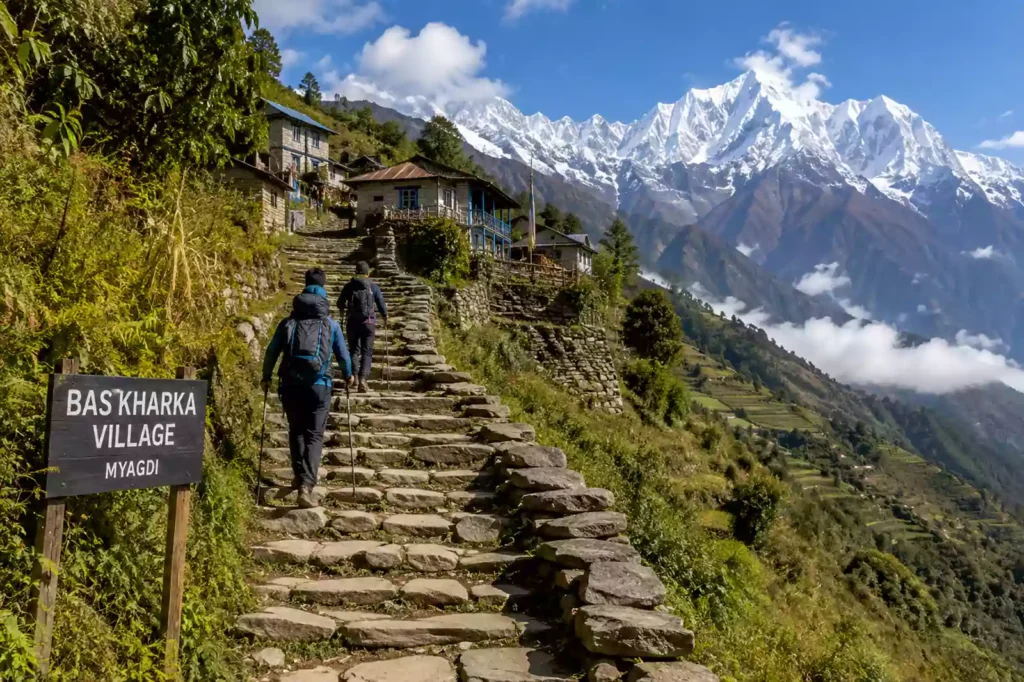
Here is the version we run. Also worth noting: any Dhaulagiri community trek guide should name real villages, not vague stages.
Day 1. Arrive in Kathmandu.
Day 2. Drive or fly to Pokhara. Afternoon by Phewa Lake.
Day 3. Drive to Beni, then climb stone staircases through terraced fields to Bas Kharka (1,500 m). Dinner sits on the floor with your host family.
Day 4. Rhododendron forest all morning to Nangi (2,300 m). This Magar village became the base for Mahabir Pun’s wireless internet project, years before the road arrived. His work later won the Ramon Magsaysay Award.
Day 5. The big day. Roughly 1,000 metres of climbing to Mohare Danda (3,300 m). Cold nights, but the mornings are the reason people come.
Day 6. A short forest descent to Danda Kharka. Afternoons here belong to the village, not to the map.
Day 7. Five to six hours down to Tikot, a village of stone walls and slate roofs.
Day 8. Down to the hot springs at Tatopani, then drive to Pokhara. Soak first.
Day 9. Return to Kathmandu.
You can see the full day-by-day breakdown, inclusions and departure dates on our Annapurna Dhaulagiri Community Trek page.
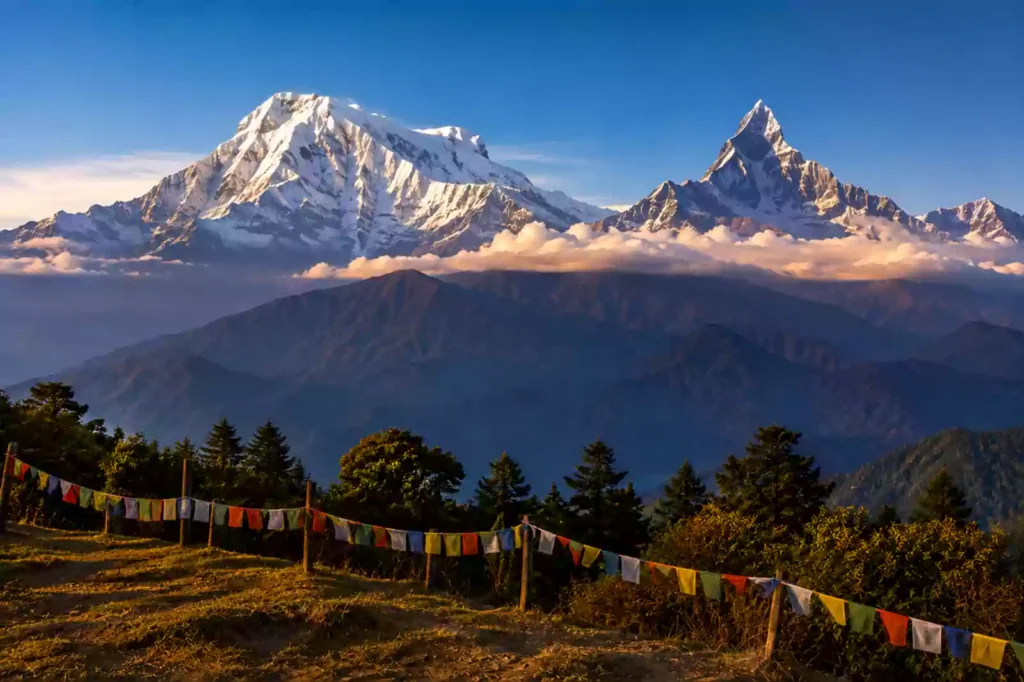
Sunrise from Mohare Danda
Dhaulagiri I and Tukuche Peak stand to the west. Across the Kali Gandaki gorge rise Annapurna South, Hiunchuli and Machhapuchhre.
Poon Hill offers a similar view at 3,210 metres. The difference is company. Poon Hill can accommodate 200 people at sunrise in October, while Mohare Danda might accommodate 6.
The light hits Dhaulagiri first. Then it moves east across the whole range in about twenty minutes.
Ready to walk it? See the full itinerary, dates and inclusions on our Annapurna Dhaulagiri Community Trek page, or send us your dates for a straight cost breakdown.
Best season, month by month
In short, March to May brings the flowers. Meanwhile, October and November bring the sharpest mountain views of the year.
Book autumn dates early, because Pokhara fills up fast. Use this Dhaulagiri community trek guide to fix your month first, then sort gear and flights.
Winter works too, because the trek stays low. Still, pack a four-season sleeping bag for Mohare Danda.
Costs and permits
Our supported 9-day package starts at USD 970 per person, down from USD 1,100.
Of course, the details matter here.
Included: permits, licensed guide, one porter per two trekkers, all trekking meals, lodge nights, and hotels in Kathmandu and Pokhara.
Excluded: flights, visa, city meals, drinks, insurance and tips.
Permits are straightforward:
- ACAP: NPR 3,000 for foreign nationals, NPR 1,000 for SAARC nationals
- TIMS: NPR 1,000 at the group rate
- Children under 10 pay nothing
Since April 2023, a licensed guide is mandatory in Nepal’s conservation areas. Therefore, both permits now go through a registered agency. Our ACAP and TIMS guide explains the process, and you can also apply through the official NTNC e-permit portal.
Additionally, around 10 percent of profit from this trek funds local community projects.
Why “community” means something here
On most Nepal trails, lodge profits leave the valley. Here they stay.
Village committees own the lodges at Nangi, Mohare Danda and Danda Kharka. That income funds the school, the health post and the trail repairs. Honestly, it is the fact every Dhaulagiri community trek guide should lead with.
Consequently, how you spend matters as much as where you walk.
- Eat where you sleep, so the lodge keeps its full margin
- Refill your bottle instead of buying plastic
- Pay the posted price, then tip separately
- Ask before photographing people, especially children
Where you sleep and eat
Set expectations properly, and you will love these lodges.
For example, rooms are simple: a bed, a blanket, a window. Bathrooms are shared, while showers run on buckets or solar heat. Food means dal bhat, and the vegetables come from the village garden.
Solar power charges phones slowly. Consequently, treat a week mostly offline as part of the deal.
Our trekking equipment list covers what to bring. Three things matter most: broken-in boots, a warm sleeping bag and a headtorch.
Who this trek suits
It works well for first-time trekkers, families with children over eight, and anyone with two weeks or less. Photographers and slow walkers do well here too, because nobody is pushing past you on the trail.
On the other hand, it suits you less if you want glaciers or high passes. In that case, look at Khopra Danda or browse our short treks in Nepal roundup.
Altitude is a minor worry here. Still, read our notes on altitude sickness before any Himalayan trip.
Frequently asked questions
How hard is the Dhaulagiri Community Trek?
Moderate, with one tiring day. No Dhaulagiri Community Trek guide should pretend otherwise, since day five climbs about 1,000 metres. However, nothing on the route is technical.
How high does it go?
Mohare Danda, at 3,300 metres. Since the trail stays below 3,500 metres, altitude risk remains low.
What permits do I need?
An ACAP at NPR 3,000, plus a TIMS card at NPR 1,000. A registered agency arranges both, and a licensed guide is mandatory.
When is the best time to go?
March to May for rhododendron blooms, and then October and November for the clearest views. Avoid June to early September, when monsoon clouds hide the range.
Is it suitable for beginners?
Yes. In fact, it is one of the better first treks in Nepal because the altitude remains modest and the villages make the experience.
Where do I sleep?
In community-owned lodges and homestays at Bas Kharka, Nangi, Mohare Danda, Danda Kharka and Tikot.
Do I need a guide?
Yes. Since April 2023, foreign trekkers in Nepal’s conservation areas must walk with a licensed guide from a registered agency. On this route, the guide is also your introduction to the villages.
How much does it cost?
From USD 970 per person, fully supported. Budget another USD 100 to 150 for tips and personal spending.
Walk the quiet side of Annapurna
Nepal has plenty of famous trails, and they are famous for good reasons. This one earns its place differently, because your money stays on the hillside you walked across.
Use this Dhaulagiri community trek guide as your starting point, then tell us your dates and fitness. We shape the route around you.
Book the Dhaulagiri Community Trek or ask us a question before you commit.