

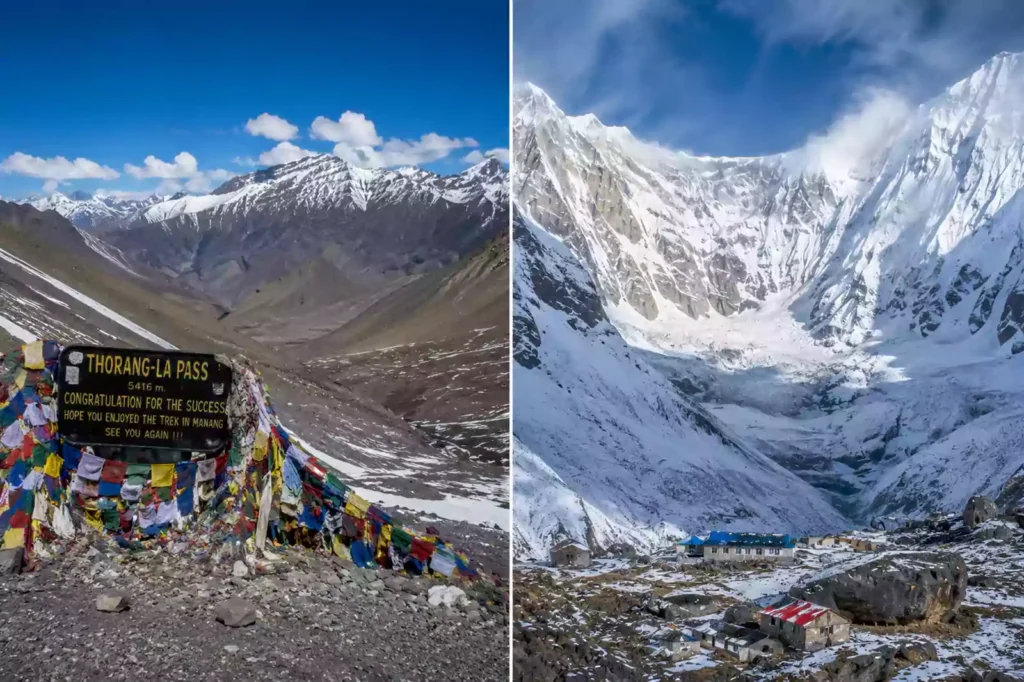
The Annapurna Circuit is a 14 to 18-day loop crossing Thorong La Pass at 5,416 m through diverse landscapes and ethnic cultures, while Annapurna Base Camp is a 10 to 14-day out-and-back journey into the heart of the Annapurna Sanctuary at 4,130 m — one offers epic variety, the other offers intimate mountain immersion.
The Annapurna Circuit vs Annapurna Base Camp debate is one of the most common questions our team receives every season. Both routes explore the same mountain range and share access from Pokhara. However, they deliver genuinely world-class Himalayan scenery in completely different ways. However, they are fundamentally different experiences. The Circuit is a grand adventure across multiple climate zones, high passes, and deeply varied cultures. The Base Camp trek is a focused journey deep into one of the most dramatic mountain sanctuaries on earth. Our guides have led both routes for over a decade, and this guide gives you everything you need to make the right choice.
Furthermore, the right answer depends entirely on your available time, fitness level, and what you want from a Himalayan trek. Trekkers seeking length, diversity, and a genuine high-altitude challenge will find the Annapurna Circuit Trek the right fit. Those wanting a complete mountain experience in a shorter, more accessible format will prefer the Annapurna Base Camp Trek.
At a Glance: Annapurna Circuit vs Annapurna Base Camp
| Factor | Annapurna Circuit | Annapurna Base Camp |
| Duration | 14 to 18 days | 10 to 14 days |
| Route type | Loop (circuit) | Out-and-back |
| Maximum altitude | 5,416 m at Thorong La Pass | 4,130 m at ABC |
| Total distance | 160 to 230 km | 110 to 115 km |
| Difficulty | Moderate to strenuous | Moderate |
| Best for | Experienced trekkers | Beginners to intermediate |
| Access | Drive to Besisahar | Drive to Nayapul or Phedi |
| Landscapes | Subtropical to high-altitude desert | Forest to alpine glacier |
| Crowds | Lower than ABC | Higher on the main trail |
| Approx. cost (guided) | USD 900 to 1,500 | USD 700 to 1,200 |
| Permits | ACAP + TIMS | ACAP + TIMS |
What Is the Annapurna Circuit Trek?
The Annapurna Circuit is one of the world’s classic long-distance trekking routes. It loops around the entire Annapurna Massif, covering 160 to 230 km depending on starting and ending points. Starting at Besisahar, the route travels counter-clockwise through the Marsyangdi Valley. It climbs through subtropical forest, terraced farmland, and high-altitude desert terrain before crossing Thorong La Pass at 5,416 m. From there, the descent leads through Muktinath and the sacred Kali Gandaki Gorge — the world’s deepest — through Jomsom and Marpha to Pokhara.
The diversity of landscape and culture on the Circuit is unmatched by any other trek in Nepal. In a single journey, you walk through Gurung, Magar, Thakali, and Tibetan Buddhist communities. The terrain shifts from lush river valleys to a high-altitude desert plateau that genuinely resembles Tibet. Additionally, optional side treks to Tilicho Lake at 4,919 m and the Nar Phu Valley add further depth for trekkers who want more. Our Tilicho Lake Trek page covers the full detour itinerary for trekkers considering that extension.
Which Trek Is Harder — Circuit or Base Camp?
The Annapurna Circuit is significantly harder than the Annapurna Base Camp trek. Thorong La Pass at 5,416 m is higher than Everest Base Camp at 5,364 m. The Circuit covers more than twice the distance of ABC, demands more daily walking hours, and crosses genuinely challenging high-altitude terrain. Furthermore, the pre-dawn Thorong La crossing demands proper acclimatisation, physical preparation, and the right gear for cold and wind above 5,000 m.
The Annapurna Base Camp trek is rated moderate. A healthy beginner who walks regularly for four to six weeks before the trip manages it comfortably. The steepest section is the climb from Chhomrong to Himalaya Hotel. However, the trail is well-maintained throughout, and tea houses are closely spaced, so no single day becomes overwhelming.
Our fitness recommendations:
- For the Annapurna Circuit: Prior high-altitude experience above 4,000 m is strongly recommended. Train 10 to 12 weeks with loaded pack hikes
- For Annapurna Base Camp: No prior high-altitude experience required. Four to six weeks of regular walking or hiking is sufficient
- For both: Carry a pulse oximeter, acclimatise properly at Manang (Circuit) or Deurali (ABC), and read our altitude sickness guide before departure
How Do the Landscapes Compare?
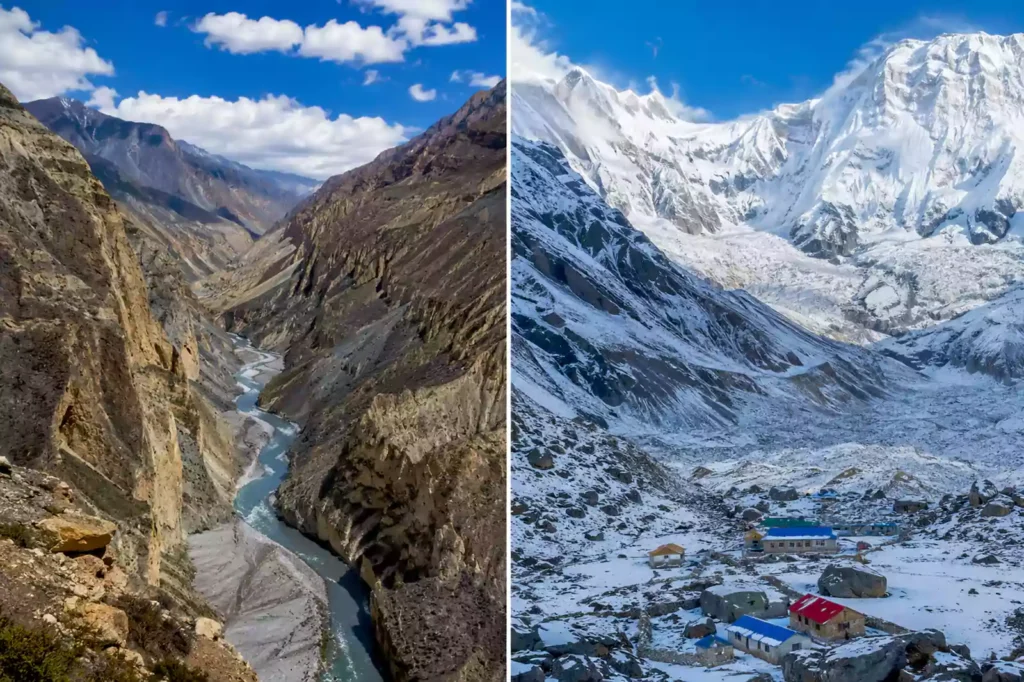
This is where the two treks differ most dramatically. The Annapurna Circuit offers extraordinary landscape diversity. In fact, no two days look alike. You begin in a humid subtropical forest at 800 m. By the end, you walk a high Tibetan-style plateau above 5,000 m. In between, the terrain moves through river gorges, irrigated farmland, pine and rhododendron forest, alpine meadows, glacial moraine, and windswept semi-desert. In contrast, the Kali Gandaki Gorge section on the descent is unlike any other landscape in Nepal.
The Annapurna Base Camp trek offers a single, sustained landscape narrative. The trail funnels you into an ever-narrowing valley, the walls growing taller as you ascend. By the time you reach the sanctuary, you are completely enclosed by glaciated peaks. As a result, the effect is one of the most powerful mountain experiences in the Himalaya. Additionally, the rhododendron corridor between Chhomrong and Machhapuchhre Base Camp is one of Nepal’s finest forest trekking sections — extraordinary in spring when the forest is in full bloom.
How Do the Cultures Compare?
The Annapurna Circuit passes through one of the most ethnically diverse corridors in Nepal. The lower Marsyangdi Valley takes you through Gurung and Magar villages. Manang is home to a distinct high-altitude trading community with strong Tibetan Buddhist traditions. The Mustang section through the Kali Gandaki brings you into contact with Thakali culture — Nepal’s most refined mountain cuisine comes from this valley. Notably, each community has its own language, dress, and religious practice.
The Annapurna Base Camp trek focuses primarily on Gurung culture in the lower and middle sections. Villages like Ghandruk and Chhomrong are among the best-preserved Gurung settlements in Nepal. The community museum in Ghandruk offers an excellent introduction to Gurung traditions, clothing, and history. Those who want to explore the spiritual dimension of the Annapurna region more deeply can read our spiritual tourism in Nepal guide for context on the Buddhist and Hindu heritage sites along both routes.
How Do the Costs Compare?
| Item | Annapurna Circuit | Annapurna Base Camp |
| ACAP permit | USD 30 per person | USD 30 per person |
| Licensed guide (per day) | USD 30 to 40 | USD 30 to 40 |
| Porter (per day) | USD 25 to 30 | USD 25 to 30 |
| Tea house (per night) | USD 8 to 20 | USD 8 to 18 |
| Total guided trip | USD 900 to 1,500 | USD 700 to 1,200 |
The Circuit costs more overall simply because it takes longer. The daily cost per person is similar on both routes. Both treks require the Annapurna Conservation Area Permit (ACAP) at USD 30 per person. Under Nepal’s 2025 mandatory guide regulation, introduced by the Nepal Tourism Board and TAAN (Trekking Agencies’ Association of Nepal), all foreign trekkers in conservation areas must travel with a licensed guide. Our trekking permit guide covers the current 2026 fee structures for both routes.
When Is the Best Time for Each Trek?
Spring (March to May) and autumn (September to November) are the prime seasons for both routes. Spring brings rhododendron blooms across the lower and mid-elevation forest zones of both trails. October offers the clearest mountain views of the year after the monsoon clears the atmosphere.
The Annapurna Circuit carries one additional seasonal consideration. Thorong La Pass at 5,416 m can be completely closed during heavy winter snowfall. December and January crossings are possible but carry a real risk of the pass being closed. By contrast, the Annapurna Base Camp trek remains open throughout winter because the maximum altitude of 4,130 m remains below the threshold at which severe snowpack builds. Consequently, ABC is the better choice for trekkers with winter travel dates. Our trekking season guide covers monthly conditions across both routes in detail.
Which Trek Should You Choose?
Choose the Annapurna Circuit if:
- You have 16 to 18 days available
- You want maximum landscape and cultural diversity in a single trek
- You have prior high-altitude trekking experience above 4,000 m
- Crossing a genuine 5,000 m+ high pass is on your list
- You want the world’s deepest gorge and a Tibetan plateau experience
Choose Annapurna Base Camp if:
- You have 10 to 14 days available
- You want an intimate mountain sanctuary experience
- This is your first serious Himalayan trek
- You want extraordinary close-up views of 8,000 m peaks
- You prefer a well-supported, clearly defined route
In fact, many of our repeat trekkers do ABC first and return for the Circuit once they have the altitude confidence. In short, ABC is the best first serious Himalayan trek. The Circuit is the better choice for experienced trekkers seeking the full Annapurna experience. Those interested in comparing more routes before deciding can also read our EBC vs Gokyo Lakes Trek comparison for a broader picture of Nepal’s major trekking options.
Ready to book? Contact our team via the inquiry page, and we will build a custom itinerary around your dates, fitness level, and budget. We respond within 24 hours.
“The Annapurna Circuit gives you the whole Himalaya in one loop. The Base Camp gives you one moment — standing inside the sanctuary — that people spend the rest of their lives talking about. Choosing between them is not about which is better. It is about which one you are ready for right now.” — Nepal Footprint Holiday senior guide, Annapurna region specialist with 12 years of field experience.
Frequently Asked Questions: Annapurna Circuit vs Annapurna Base Camp
Q1. Which is harder, the Annapurna Circuit or Annapurna Base Camp?
The Annapurna Circuit is significantly harder. It covers 160 to 230 km over 14 to 18 days and crosses Thorong La Pass at 5,416 m. The Annapurna Base Camp trek covers 110 to 115 km over 10 to 14 days with a maximum altitude of 4,130 m. ABC suits fit beginners. The Circuit suits experienced trekkers with prior altitude experience above 4,000 m.
Q2. Which trek has better mountain views, Circuit or Base Camp?
Both treks offer outstanding mountain views in different ways. Specifically, the Annapurna Circuit delivers panoramic views across Annapurna, Dhaulagiri, Manaslu, and Machhapuchhre from multiple viewpoints. The Annapurna Base Camp trek delivers something more dramatic: you stand completely enclosed inside the glacial sanctuary with 8,000 m peaks rising on all sides. For the most intimate mountain experience, ABC wins. For the widest mountain panorama, the Circuit wins.
Q3. Can I do both the Annapurna Circuit and Base Camp in one trip?
Yes. A combined Annapurna Circuit and Base Camp itinerary is possible in approximately 22 to 26 days. The most practical approach involves completing the Circuit first. Then connect to the ABC trail via Pokhara for the base camp section. Our team designs custom combined itineraries for trekkers with three to four weeks available. Contact us via the inquiry page for a detailed combined itinerary and quote.
Government of Nepal registered · Kathmandu-based · 10+ years guiding experience