

The Poon Hill trek budget guide 2026 covers a fully guided 8-day circuit from Pokhara costing between USD 450 and USD 700 per person, including permits, a licensed guide, a porter, tea house accommodation, all meals, and transport — making it Nepal’s most accessible Himalayan trek by both difficulty and price.
The Poon Hill trek is the most popular short trek in Nepal for one simple reason. It delivers rhododendron forests, Gurung village culture, and a sunrise panorama of 32 snow-capped peaks including Annapurna (8,091 m) and Dhaulagiri (8,167 m). All of that fits into eight days. Moreover, it costs a budget most travellers can manage without stretching their limits. Our team has guided the Poon Hill Trek every season for over a decade. This guide gives you every cost, every permit, and every practical detail you need to plan your 2026 budget accurately.
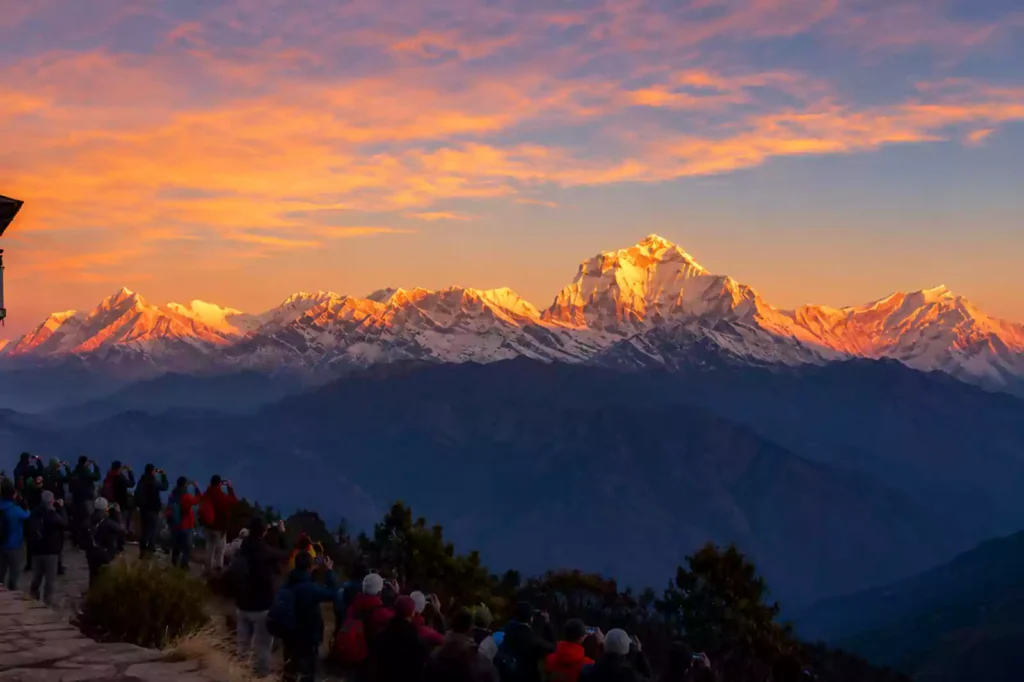
However, 2026 has brought one important rule change. As of this year, independent solo permits are no longer issued for Poon Hill and the broader Annapurna Conservation Area. All foreign trekkers must book through a licensed guide affiliated with a registered agency. In short, self-guided Poon Hill trekking without agency involvement is no longer possible. Consequently, every trekker now has professional safety support on the trail.
What Is the Poon Hill Trek?
The Poon Hill trek follows the classic Ghorepani circuit in the Annapurna region, starting and ending near Pokhara. The standard 8-day version from Kathmandu reaches a maximum altitude of 3,210 m at the Poon Hill viewpoint. Consequently, no serious acclimatisation days are needed, making this the most accessible high-viewpoint trek in Nepal.
| Day | Route | Hours |
| 1 | Drive Kathmandu to Pokhara | 6 to 7 hrs (bus) |
| 2 | Pokhara to Nayapul, trek to Tikhedhunga (1,540 m) | 3 to 4 hrs |
| 3 | Tikhedhunga to Ghorepani (2,860 m) | 5 to 6 hrs |
| 4 | Poon Hill sunrise (3,210 m), trek to Tadapani (2,630 m) | 5 to 6 hrs |
| 5 | Tadapani to Ghandruk (1,940 m) | 3 to 4 hrs |
| 6 | Ghandruk to Nayapul, drive to Pokhara | 4 hrs trek |
| 7 | Rest day in Pokhara | — |
| 8 | Drive or fly from Pokhara to Kathmandu | — |
For the complete day-by-day itinerary with altitude profiles, accommodation details, and optional extensions, visit our Poon Hill Trek page.
Those looking for a slightly longer challenge can extend the route toward the Annapurna Base Camp Trek by continuing from Ghandruk into the Modi Khola valley.
What Permits Do You Need for the Poon Hill Trek in 2026?
Two permits are required for the Poon Hill trek in 2026:
| Permit | Cost (Foreign) | Cost (SAARC) | Where to Get |
| Annapurna Conservation Area Permit (ACAP) | NPR 3,000 (~USD 22) | NPR 1,000 | Nepal Tourism Board, Kathmandu or Pokhara |
| TIMS Card | NPR 2,000 (individual) /
NPR 1,000 (group) |
NPR 600 | TAAN Office, Kathmandu or Pokhara |
| Total permit cost | ~NPR 4,000 to 5,000 (~USD 30 to 38) |
Both permits are checked at the Birethanti checkpoint at the start of the trail and at several points along the Ghorepani circuit. Our guides collect permits in Pokhara before departure. Under Nepal’s 2025 mandatory guide regulation, all foreign trekkers in the Annapurna Conservation Area must trek with a certified guide. This rule was introduced by the Nepal Tourism Board and the Trekking Agencies’ Association of Nepal (TAAN). Our full trekking permit guide covers the complete 2026 application process for both permits.
How Much Does the Poon Hill Trek Cost in 2026?
ivate guided 8-day trek:
| Item | Budget Option | Mid-Range Option |
| ACAP + TIMS permits | USD 30 to 38 | USD 30 to 38 |
| Licensed guide (6 days on trail) | USD 180 to 240 | USD 240 to 300 |
| Porter (6 days, 1 porter per 2 trekkers) | USD 150 to 180 | USD 150 to 180 |
| Tea house accommodation (6 nights) | USD 30 to 60 | USD 60 to 120 |
| Meals on trail (3 meals x 6 days) | USD 72 to 100 | USD 100 to 150 |
| Pokhara accommodation (2 nights) | USD 20 to 40 | USD 50 to 100 |
| Kathmandu to Pokhara transport | USD 15 to 25 (bus) | USD 80 to 120 (flight) |
| Nayapul jeep transfer | USD 15 to 25 | USD 15 to 25 |
| Guide and porter tips (recommended) | USD 30 to 50 | USD 50 to 80 |
| Total per person | USD 542 to 738 | USD 775 to 1,113 |
Additionally, travel insurance covering high-altitude trekking and helicopter evacuation costs approximately USD 80-150 per person. We strongly recommend it. Without insurance, a helicopter evacuation costs USD 3,000 to 5,000.
What Does Tea House Accommodation Cost on the Poon Hill Trek?
Tea house accommodation on the Poon Hill trek runs from USD 5 to 15 per night for a twin room. Most tea house owners on the Ghorepani circuit offer rooms at very low rates, sometimes free on the understanding that you eat all meals there. Furthermore, our guides always brief trekkers on this arrangement before departure. Eating meals at your own tea house is both expected and genuinely the best way to support the local families who run these lodges.
Meals cost between USD 4 and USD 8 per dish on the trail. Dal bhat is consistently the best value: unlimited refills, freshly cooked, and the single most energising meal for a full day of trekking. Hot drinks, snacks, and chocolate bars add another USD 5 to 15 per day depending on your appetite.
How to Save Money on the Poon Hill Trek in 2026
The Poon Hill trek is already one of Nepal’s most affordable mountain experiences. However, a few practical steps can reduce your total budget further without compromising safety or experience:
- Travel by tourist bus, not flight: The bus costs USD 15 to 25 versus USD 80 to 120 for a domestic flight. The bus takes 6 to 7 hours on a scenic highway
- Join a group departure: Specifically, joining a group trek rather than booking privately splits guide and porter costs significantly. Nepal Footprint Holiday runs group Poon Hill departures at significantly lower per-person rates
- Eat dal bhat: At USD 5 to 7 per plate with unlimited refills, it costs half what pasta or pizza costs and gives you more energy for the trail
- Trek in shoulder season: March, April, and November offer ideal conditions and lower accommodation rates than peak October
- Carry a reusable water bottle: Buying bottled water at altitude costs USD 1.50 to 3.00 per bottle. Water purification tablets or a filter cost USD 5 to 10 total for the entire trek
- Book directly with a Kathmandu-based operator: Booking with Nepal Footprint Holiday directly saves 20 to 35 percent compared to international booking platforms
Those ready for a bigger challenge after Poon Hill can explore the Annapurna Circuit Trek, the Jomsom Muktinath Trek, or the Khopra Danda Trek as natural next steps from Pokhara.
When Is the Best Time for the Poon Hill Trek?
Best seasons: Spring (March to May) and Autumn (September to November)
- October to November — clearest sunrise views from Poon Hill, sharpest mountain panorama
- March to April — rhododendron forest in full bloom, the Tikhedhunga to Ghorepani trail at its most beautiful
- December to January — possible but cold (-5°C at night in Ghorepani), requires extra down layer and warmer sleeping bag
- June to August — heavy monsoon rain, not recommended for budget trekkers without wet-trail experience
For monthly temperature and trail conditions across the Annapurna region, see our trekking season guide. Trekkers with less time can find 4 and 5-day Poon Hill options in our short treks in Nepal guide.
Is the Poon Hill Trek Suitable for Beginners?
Yes. The Poon Hill trek is rated easy to moderate and suits first-time trekkers with good general fitness. The maximum altitude of 3,210 m is well within the range most healthy adults manage without altitude-related problems. Daily walking times range from 3 to 6 hours on well-maintained trails. Furthermore, the trail is never technically demanding — there are no exposed ridge crossings, no river fords, and no glacier terrain. In fact, a trekker who walks regularly for four to six weeks beforehand will find the Poon Hill trek comfortable throughout. Those wanting to compare difficulty across routes can read our overview of trekking in Nepal before booking.
“The Poon Hill sunrise is the moment every first-time trekker in Nepal remembers for the rest of their life. Standing on that viewpoint at 3,210 m with Annapurna and Dhaulagiri lit up in gold — there is nothing quite like it anywhere in the world, and it costs a fraction of what most people expect.” — Nepal Footprint Holiday senior guide, Annapurna region specialist with 11 years of field experience.
Government of Nepal registered · Kathmandu-based · 10+ years guiding experience
Frequently Asked Questions About the Poon Hill Trek Budget Guide 2026
Q1. How much does the Poon Hill trek cost in 2026?
A fully guided 8-day Poon Hill trek from Kathmandu costs between USD 450 and USD 700 per person on a budget package. This covers permits, a licensed guide, a porter, tea house accommodation, all meals on trail, and transport. Mid-range packages with flight transfers and better accommodation run USD 775 to USD 1,100 per person. The biggest variable is whether you fly or take the bus between Kathmandu and Pokhara.
Q2. Do I need a guide for the Poon Hill trek in 2026?
Yes. As of 2026, all foreign trekkers in the Annapurna Conservation Area must be accompanied by a licensed guide from a registered trekking agency. Independent solo permits are no longer issued. Nepal Footprint Holiday provides government-certified English-speaking guides on all Poon Hill departures. Booking through a registered agency also qualifies you for the lower group TIMS rate of NPR 1,000 rather than the individual rate of NPR 2,000.
Q3. What is the best month for the Poon Hill trek in 2026?
October is the single best month for the Poon Hill trek. Post-monsoon skies are crystal clear, and the rhododendron forest is green and fresh. The sunrise from Poon Hill at 3,210 m delivers the sharpest mountain panorama of the year. March and April are the second-best window, with the rhododendron forest in full bloom and excellent mountain visibility before the pre-monsoon haze builds.