

The Kanchenjunga Base Camp Trek is an 18 to 24-day restricted-area route in eastern Nepal, reaching the North Base Camp at 5,143m and South Base Camp at 4,780m on the world’s third-highest mountain.
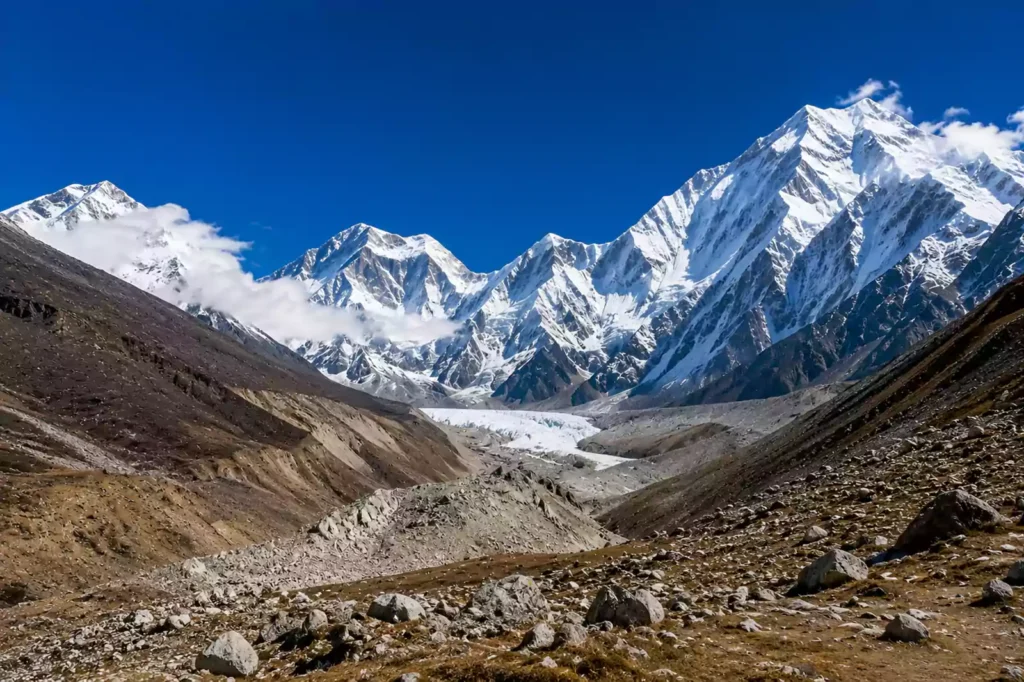
The Kanchenjunga Base Camp Trek takes trekkers to the foot of Kanchenjunga (8,586m), the world’s third-highest mountain. While Everest Base Camp is one of the most commercially popular routes in Nepal, Kanchenjunga Base Camp receives fewer than 1,000 trekkers a year. Furthermore, most who complete it describe it as one of the most challenging yet rewarding experiences of their lives.
Having led several expeditions on this route across different seasons, we can address real-world trail conditions and provide honest, firsthand preparation advice. Therefore, this guide covers permits, costs, itinerary, difficulty, and the insider details only a local operator would know.
What Is the Kanchenjunga Base Camp Trek?
The Kanchenjunga Base Camp Trek winds through the high, remote terrain of Taplejung District in eastern Nepal. It reaches both the North Base Camp at 5,143m and the South Base Camp at 4,780m.
The region holds Restricted Area status. A special permit and a licensed guide are mandatory under Nepal’s 2025 trekking regulations. Solo independent trekking on this route is not legally permitted.
What Makes the Kanchenjunga Base Camp Trek Nepal’s Most Beautifully Isolated Trek?
The Kanchenjunga Base Camp Trek is the most remote and isolated route in Nepal. Most trekking routes carry thousands of groups each season. This trek is the complete opposite.
The teahouses are simple family homes. The villages are so unaccustomed to visitors that children run alongside trekking groups to watch.
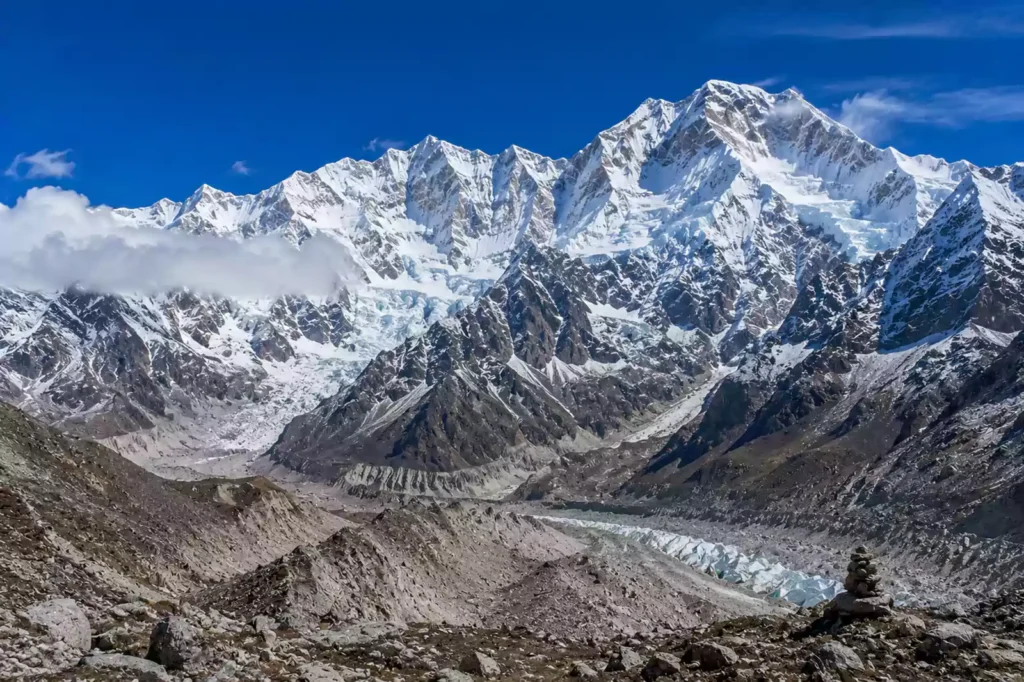
However, the isolation is only part of the story. The biodiversity in the Kanchenjunga Conservation Area is spectacular. The route crosses subtropical rhododendron forests, wildflower alpine meadows, and glacial moraines beneath ice walls 3,000 metres tall. In fact, the Kanchenjunga Conservation Area was Nepal’s first community-managed conservation area, opened in 1997.
Trekkers who have done the Everest High Passes Trek and Manaslu Circuit all agree that Kanchenjunga is the most visually striking of all. The mountain is wider, closer, and more complex than any other 8,000-metre peak seen from a Nepal trail.
Vibe Check
- True wilderness solitude
- Subtropical jungle to glacial moraine
- Culturally untouched Limbu and Tibetan villages
- The world’s third-highest mountain, close enough to hear the ice
- No crowds, no queues, no mobile signal
Kanchenjunga Base Camp Trek at a Glance
📍
Plan your Kanchenjunga Base Camp Trek with Nepal Footprint Holiday, Government of Nepal registered and based in Kathmandu.
How Difficult Is the Kanchenjunga Base Camp Trek?
The Kanchenjunga Base Camp Trek is the most demanding long-distance trek in Nepal. It features long daily stages, significant elevation gain, and remote trails with sections that require precise navigation. Trekkers walk between 6 and 9 hours every day.
The trail infrastructure here is far less developed than on the Everest or Manaslu routes. There are no busy lodge towns, no bakeries, and no reliable charging stations above the lower villages. Moreover, reaching North Base Camp involves sleeping above 4,500m for multiple consecutive nights, making altitude sickness a serious risk.
Trekkers with little experience above 5,000m should build up on shorter technical routes first. Our guides carry supplemental oxygen and pulse oximeters and follow strict acclimatization protocols throughout. Specifically, completing at least one prior high-altitude route — such as a high-altitude Everest route — is strongly recommended before attempting Kanchenjunga.
Our fitness recommendation:
- Train with loaded pack hikes for 12 to 16 weeks before departure
- Build to 8 to 10-hour days carrying 10 to 12kg on steep terrain
- Consult a travel medicine clinic about Diamox before departure
- Complete at least one prior trek above 5,000m
Insider Tips
- Best season: October delivers the most predictable weather and stable high-camp conditions at both base camps
- Local food to try: Tongba, a warm millet beer served in a wooden vessel, unique to the Limbu people of eastern Nepal
- Access: fly Kathmandu to Bhadrapur, then a connecting flight or jeep to Taplejung; allow a full travel day for this journey
What Permits Do You Need for the Kanchenjunga Base Camp Trek?
The Kanchenjunga Base Camp Trek requires two permits, both arranged in Kathmandu before departure. There are no permit offices in Taplejung or beyond.
According to Nepal’s 2025 regulation, all trekkers in restricted areas must be accompanied by a TAAN-licensed guide. This route cannot be trekked independently. Our Kathmandu office processes all permits within 24 hours of arrival.
For current official permit fees, visit the Nepal Tourism Board website. International visitors should also check Nepal visa requirements well before booking, as eastern Nepal flight connections require advance planning.
Additionally, trekkers planning other Nepal routes should check the Nepal trekking permit guide for a complete listing of all permit costs and procedures.
What Is the Best Kanchenjunga Base Camp Trek Itinerary?
The best Kanchenjunga Base Camp Trek itinerary covers both the North and South Base Camps in a single 20 to 22-day loop. Shorter versions visiting only one base camp take 14 to 16 days but miss the full mountain circuit.
Most itineraries fly from Kathmandu to Bhadrapur or Suketar Airport in Taplejung, then trek through Chirwa, Sekathum, and Ghunsa toward the North Base Camp approach.
Route Highlights
The classic circuit starts in Taplejung and follows the Tamor River north through subtropical jungle. The trail climbs steadily through Chirwa, Sekathum, and Ghunsa — the last permanent village before the glacier approach at 3,595m. From Ghunsa, the route pushes to Lhonak at 4,780m before the final ascent to North Base Camp at 5,143m.
The return crosses the Sele La Pass at 4,615m and descends into the Tseram valley to reach the South Base Camp at 4,780m. Then the trail drops through Yamphudin and the cardamom-farming villages of the lower valley before returning to Taplejung.
For the complete day-by-day itinerary, accommodation details, route map, and 2026 package pricing, visit our Kanchenjunga Base Camp Trek trip page.
How Much Does the Kanchenjunga Base Camp Trek Cost?
The Kanchenjunga Base Camp Trek costs between USD 2,000 and USD 3,500 per person. The final price depends on group size and itinerary length. Because infrastructure is minimal here, porter and guide costs form a larger share of the total budget.
Booking directly with Nepal Footprint Holiday saves 20 to 35 percent compared to international agencies. Smaller group sizes also dramatically improve the experience on a route this remote. Trekkers comparing cost and commitment often start with the Poon Hill Trek before stepping up to Kanchenjunga.
Travel insurance covering high-altitude trekking and helicopter evacuation is mandatory for all international trekkers. Evacuation from Kanchenjunga costs USD 5,000 to 10,000 without coverage. Fortunately, World Nomads, True Traveller (UK), and ERGO (EU) all offer suitable high-altitude policies.
What Are the Villages Like on the Kanchenjunga Base Camp Trek?
Villages on this route are among the most ethnically diverse and least-visited in the Nepal Himalayas.
Ghunsa is the last village before the glaciers, sitting at 3,595m in a wide valley backed by an ice-and-rock wall. The village is primarily Tibetan, with a functioning gompa, mani walls, and prayer flags at every entrance. Although remote, local families run simple teahouses and welcome trekking groups with genuine warmth.
Sekathum marks the point where the subtropical Tamor River valley opens into higher terrain. The Limbu people of the lower valley maintain their own distinct language, dress, and traditions. Specifically, the Limbu are one of Nepal’s oldest indigenous peoples, and their script, Sirijonga, is still taught in local schools.
Yamphudin is well known for its vast cardamom fields. Therefore, the hills carry the fragrance of cardamom drying throughout October and November — one of the most memorable sensory details of the entire route.
Village Insider Tips
- Best time for village visits: October, after the cardamom harvest and with clear post-monsoon skies
- Local food: dried pork, fermented vegetables, and tongba millet beer are staples in the lower Limbu valley
- Gear note: bring a quality headlamp with spare batteries; electricity is intermittent above Chirwa
Is the Kanchenjunga Base Camp Trek Safe?
The Kanchenjunga Base Camp Trek is safe with experienced guides, realistic fitness preparation, and strict acclimatization discipline. Nevertheless, it is the most committing trek in Nepal and poor planning carries the highest consequences here.
Since 2025, Nepal requires all restricted-area trekkers to hire a government-licensed guide. On this route, the regulation carries real weight: so few people pass through that independent trekkers in difficulty could wait days for help. Our guides carry satellite phones and coordinate with helicopter rescue operators in Kathmandu throughout the journey.
The Nepal trek difficulty grading guide provides an honest comparison of all major Nepal routes for those deciding between options. In short, the Kanchenjunga Base Camp Trek sits above the Manaslu Circuit Trek and Langtang Valley Trek in difficulty. It is the trek you work toward, not the one you start with.
Government of Nepal registered · Kathmandu-based · 10+ years guiding experience
FAQ Schema: Kanchenjunga Base Camp Trek
Q: How long is the Kanchenjunga Base Camp Trek? The trek lasts 18 to 24 days. The most common itinerary is 20 to 22 days, covering both the North Base Camp at 5,143m and the South Base Camp at 4,780m in a full circuit. A 14 to 16-day version is possible but visits only one base camp and misses the complete mountain experience.
Q: What is the highest point of the Kanchenjunga Base Camp Trek? The highest point is North Base Camp at 5,143m (16,873ft), reached on approximately Day 11 after acclimatization nights at Ghunsa (3,595m) and Lhonak (4,780m). The South Base Camp at 4,780m is reached from Tseram after crossing the Sele La Pass on the return loop.
Q: Is a guide required for the Kanchenjunga Base Camp Trek? Yes. Since 2025, all trekkers in the Kanchenjunga restricted area must be accompanied by a government-licensed guide registered with TAAN. The route’s remoteness makes guide accompaniment a genuine safety necessity, not only a legal requirement.
The Mountain Nobody Knows
Kanchenjunga stands at 8,586 metres — the third-highest mountain on earth. However, most people who have never trekked in Nepal could not name it. That anonymity is precisely what makes the Kanchenjunga Base Camp Trek extraordinary.
There is no airport named after it. No brand deals. No crowds photographing sunrise at its foot. What there is instead is 22 days of unspoiled Himalayan wilderness and villages that light up with joy at the sight of visitors.
In conclusion, if you want Nepal without the tourism layer, Kanchenjunga will not disappoint. Contact our Kathmandu team, and we handle every detail.