

Lukla Airport (Tenzing-Hillary Airport) is a 2,846m mountain airstrip in Nepal’s Khumbu region, the primary gateway to Everest Base Camp via 25 to 40-minute flights from Kathmandu or Ramechhap.
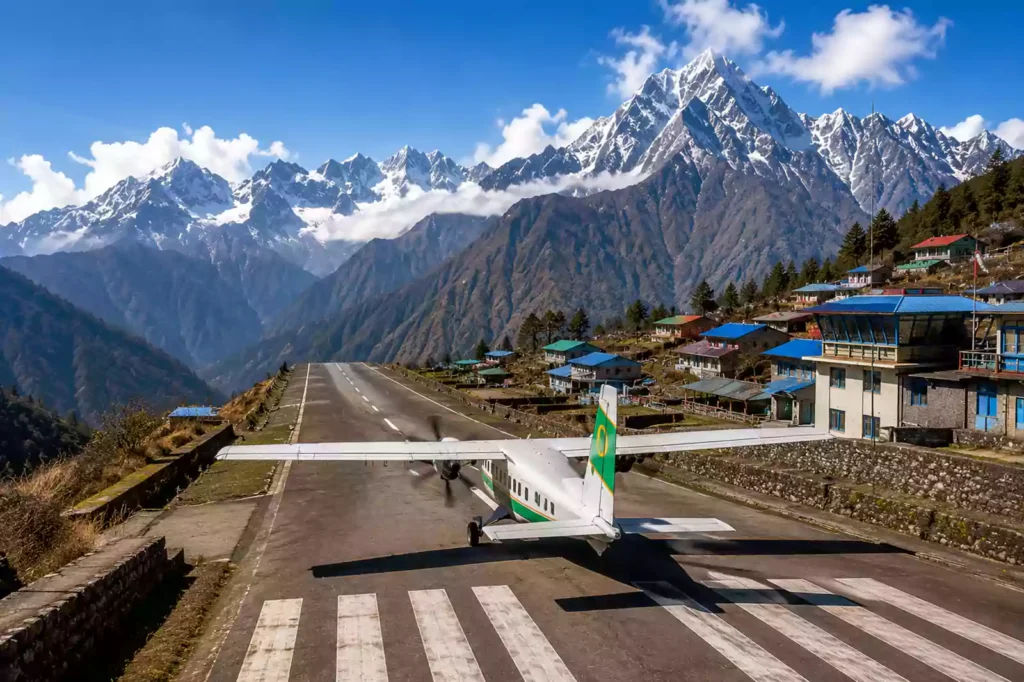
Lukla Airport is the starting point for almost every Everest region trek. Officially called Tenzing-Hillary Airport, it sits at 2,846m in the Solukhumbu District, approximately 138 kilometres northeast of Kathmandu. Furthermore, the airport’s dramatic mountain setting and 527-metre runway earn it the reputation of one of the most technically challenging airstrips in the world.
We have facilitated hundreds of Lukla departures for Khumbu trekkers. Additionally, we manage flight logistics for trekkers beginning the Langtang Valley Trek and other Kathmandu-connected routes. Therefore, this guide reflects what actually happens at Lukla Airport — the delays, the logistics, the Ramechhap shift, and everything you need to prepare confidently.
What Is Lukla Airport and Why Does Every Everest Trekker Use It?
Lukla Airport is the only airstrip with regular scheduled service to the Khumbu region. There are no roads connecting Kathmandu to the Everest trailhead. Because of this, flying to Lukla is the only way to start the Everest Base Camp Trek without committing to a 7 to 10-day walk from lowland Nepal.
Built in 1964 with funding from Sir Edmund Hillary, Lukla Airport was expanded and formalised in 1971. It was the first airport named after an Everest summiter, becoming Tenzing-Hillary Airport. However, both trekkers and locals simply call it Lukla.
Lukla Airport Quick Facts
What Makes the Lukla Airport Runway Unique?
The Lukla Airport runway is unlike anything most trekkers have seen. At 527 metres, it is roughly one-sixth the length of a typical international runway. Additionally, its 12% uphill slope helps landing aircraft slow down and gives departing aircraft the speed needed to lift off.
One end of the runway terminates at a stone wall on a mountainside. The other drops into a steep valley. If an approach is not correct, there is no go-around option for pilots. Although this sounds alarming, the runway design is a deliberate engineering solution — which is precisely why only CAAN-certified mountain pilots with specific Lukla endorsements are permitted to fly this route.
Is Lukla Airport Safe?
Lukla Airport is safe to fly into when operated within its strict weather and pilot certification requirements. With over a decade of coordinating Lukla flights, we take this question seriously.
All Lukla flights operate under Visual Flight Rules (VFR). This means pilots must maintain clear sight of the runway throughout the approach. If conditions fall below the minimum visibility threshold, flights do not depart.
Nepal’s Civil Aviation Authority (CAAN) enforces these weather minimums rigorously. Specifically, if the morning weather window does not open, no aircraft leaves regardless of passenger schedules.
The DHC-6 Twin Otter and Dornier 228 are specifically designed for Short Takeoff and Landing (STOL) in high-altitude mountain environments. Lukla pilots hold an additional mountain-flying rating, requiring hundreds of supervised landings. Consequently, the combination of purpose-built aircraft and specialist pilots makes Lukla flights fundamentally different from standard commercial operations.
Most trekkers say the flight is thrilling rather than frightening.
📍
We handle all Lukla flight bookings and logistics for your trek with Nepal Footprint Holiday, Government of Nepal registered and based in Kathmandu.
Why Do Most Lukla Flights Depart from Ramechhap?
During peak trekking seasons, most Lukla Airport flights depart from Ramechhap (Manthali Airport) rather than Kathmandu. This is the single most important logistical fact that surprises first-time Everest trekkers.
During peak season, Kathmandu’s Tribhuvan International Airport cannot handle the volume of Lukla-bound flights without dangerous congestion. Therefore, CAAN diverts these flights to Ramechhap, a smaller airstrip approximately 132 kilometres east of Kathmandu.
For trekkers, this means a 2 to 3am departure from Kathmandu and a 4 to 5-hour drive before boarding. Fortunately, the Ramechhap to Lukla flight takes only 15 to 20 minutes. Our team confirms which airport is operating and briefs trekkers the night before departure.
Flight Time Comparison
Why Do Lukla Airport Flights Get Delayed So Often?
Weather delays at Lukla Airport are the rule, not the exception. Every Everest region trekker should plan for at least one disruption.
Because Lukla operates VFR only, even modest cloud cover or early morning fog can ground all flights. Delays usually resolve by mid-morning as valley fog burns off. However, mountain weather deteriorates quickly in the afternoon. Consequently, the entire Lukla flight schedule typically finishes before noon.
Common delay causes include fog, low cloud base, rain, strong crosswinds, and spring wildfire smoke. Our operations team monitors the Lukla weather window from Kathmandu every morning and contacts trekkers directly if their departure is affected.
How Many Buffer Days Should You Plan Around Lukla Airport?
Around any Lukla Airport flight, we recommend a minimum of two buffer days — one before your trek and one after. In our experience, one day is not enough. One disruption can cascade into two or three days of delays in a bad week.
The most expensive mistake trekkers make is booking an international flight home the day after their scheduled Lukla departure. Weather-related helicopter rescue costs far more than a flexible international ticket.
The Gokyo Lake Trek and the Everest High Passes Trek both route through Lukla and require the same buffer day planning. Trekkers who add a cultural experience after their return flight often choose the Tamang Heritage Trail from Kathmandu.
What Are the Baggage Rules at Lukla Airport?
Standard baggage allowances on Lukla Airport flights are strict because aircraft weight limits are critical at high altitude.
- Checked baggage: 10kg maximum
- Hand carry: 5kg maximum
- Total allowance: 15kg per passenger
Additional baggage is charged by weight and limited by available aircraft capacity. Moreover, helicopter transfers enforce even tighter weight restrictions. Most trekkers travelling with us send heavy duffel bags with their assigned porter rather than checking them on the aircraft. Porters carry loads from Lukla onward, so oversized items do not need to fly.
Pack your daypack for the flight and keep essentials in hand carry in case of a delay. Trekkers new to Nepal often complete the Mardi Himal Trek from Pokhara before their Khumbu trip to test their gear and packing strategy.
What Should You Do When Your Lukla Airport Flight Is Cancelled?
Flight cancellations at Lukla Airport happen often enough that we build contingency plans into every trekking package.
If your fixed-wing flight is cancelled, three options exist. First, wait — airlines automatically rebook cancelled passengers on the next available departure, usually the following morning. Second, charter a helicopter — Kathmandu to Lukla helicopter costs between USD 400 and USD 550 per person depending on seat-sharing. Third, adjust your itinerary — if you built buffer days in, a one-day delay costs nothing except patience.
Travel insurance covering Lukla flight delays is essential for any Everest region trek. For official flight status and CAAN operating guidelines, visit the Civil Aviation Authority of Nepal website. Additionally, trekkers combining Lukla with Island Peak Climbing should plan a minimum of three buffer days, not two.
What Is the Best Season for Lukla Airport Flights?
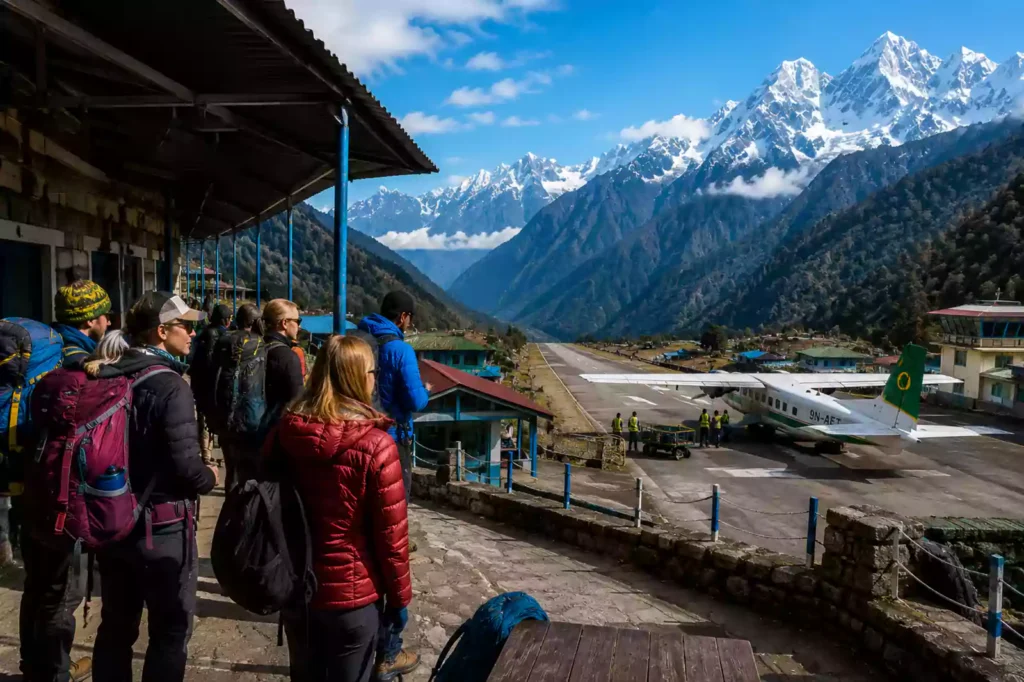
Spring (March to May) and autumn (September to November) are the best seasons for Lukla Airport flight reliability. Both offer stable weather, excellent visibility, and lower cancellation rates.
Spring coincides with the Everest Base Camp climbing season and the rhododendron bloom in the lower Khumbu valleys. Autumn brings clear post-monsoon skies. However, October is the busiest month — flights book out weeks in advance, and Ramechhap becomes the main departure hub.
Winter (December to February) and monsoon (June to August) months see more direct Kathmandu departures but also more cancellations due to snow and rain. Although the Gokyo Cho La Pass Trek is possible in most seasons, we always plan Lukla logistics around the most reliable weather windows. Trekkers wanting pre-Lukla acclimatisation sometimes add the Pikey Peak Trek in the lower Solukhumbu hills first.
Practical Tips for Flying Through Lukla Airport
These are the tips our guides give every trekker the night before their Lukla departure.
- Book early: Peak season Lukla seats sell out 6 to 8 weeks in advance — do not leave it to the last week
- Sit on the left side: Left window seats on the Kathmandu or Ramechhap to Lukla route offer the best Himalayan views on clear mornings
- Pack your carry-on for independence: Keep one layer, snacks, medication, and your trek permit in hand carry in case checked luggage is delayed
- Confirm your departure airport the night before: Our team always notifies trekkers whether their morning flight leaves from Kathmandu or Ramechhap
- Arrive early: Mountain flight check-in is quick but queues can be long during peak season — arrive 90 minutes before departure
FAQ Schema: Lukla Airport
Q: Why do Lukla flights depart from Ramechhap during peak season? To reduce congestion at Kathmandu’s Tribhuvan International Airport, CAAN diverts all peak-season Lukla flights through Ramechhap (Manthali Airport). Most trekkers leave Kathmandu at 2 to 3am for a 4 to 5-hour drive, then board a 15 to 20-minute flight to Lukla. This applies to most departures in March, April, May, October, and November.
Q: How many buffer days should I add for Lukla Airport flights? We recommend a minimum of two buffer days around Lukla Airport — one before your trek and one at the end before onward travel. Weather can ground all flights for 24 to 48 hours during fog or wind events. Booking an international flight home without buffer days is the most common and costly mistake Everest trekkers make.
Q: Which aircraft fly to Lukla Airport? Only the DHC-6 Twin Otter, Dornier 228, and LET L-410 are certified to operate at Lukla Airport. All are purpose-built for STOL operations in high-altitude mountain conditions. Furthermore, only pilots holding CAAN mountain-flying endorsements are permitted to fly this route. Large commercial aircraft cannot operate at Lukla under any circumstances.
Government of Nepal registered · Kathmandu-based · 10+ years guiding experience
The Flight Is Not the Obstacle — It Is the Beginning
Every trekker who has flown into Lukla Airport has a story. The aircraft banks steeply. The runway appears suddenly on the hillside. The wheels touch down, and the mountains are right there.
There will always be weather delays. Ramechhap mornings can be tiring. However, not one trekker who has stood at the edge of the Lukla airstrip with the mountains ahead has ever said it was not worth it.
In conclusion, contact our Kathmandu team for all Everest region trek preparations. We handle every Lukla flight booking, weather contingency, and airport transfer — so you can focus entirely on the mountains.