


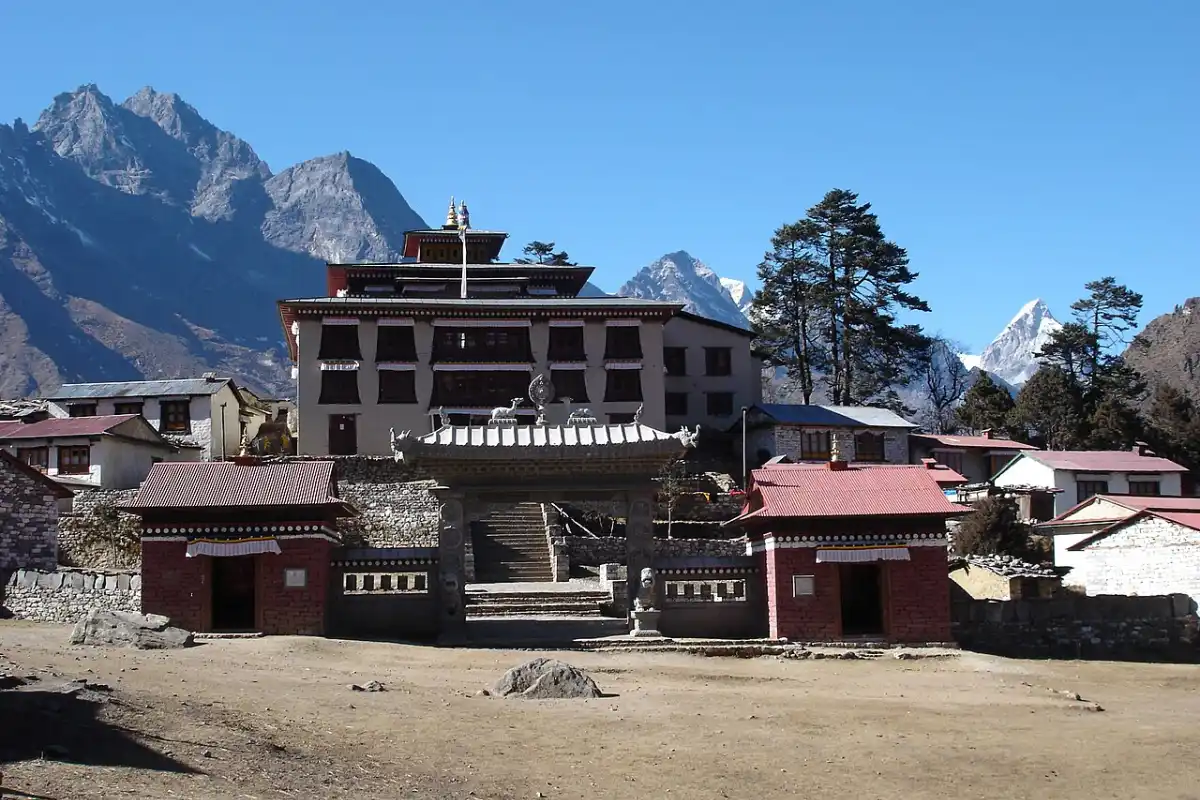
Tengboche Monastery sits on a grassy ridge at about 3,867 m (12,687 ft), and most trekkers reach it on the third or fourth day of the Everest Base Camp trek, sweaty and short of breath after the long climb from the river. Then the trail tops out, the painted gate comes into view, and Ama Dablam fills the sky behind the prayer hall. It is one of those places that makes the whole trek make sense.
Tengboche (also written Tengpoche or Thyangboche) is the largest and most important Buddhist monastery in the Khumbu. It is a working gompa, home to dozens of monks, and the spiritual centre for the Sherpa villages of the Everest region. This guide covers its history, the Mani Rimdu festival, the route from Namche, prayer times, etiquette, and where to stay.
Tengboche Monastery at a Glance
| Altitude | About 3,867 m (12,687 ft) |
| Location | Khumbu Pasang Lhamu Rural Municipality, Solukhumbu, inside Sagarmatha National Park |
| Founded | 1916, by Lama Gulu |
| Buddhist school | Nyingma (the oldest school of Tibetan Buddhism) |
| Walk from Namche Bazaar | About 10 km, 5 to 6 hours |
| Main festival | Mani Rimdu, October or November |
| Mountain views | Everest, Lhotse, Nuptse, Ama Dablam, Thamserku, Kangtega, Taboche |
| Permits needed | Sagarmatha National Park entry and Khumbu Pasang Lhamu municipality fee |
Where Is Tengboche Monastery?
Tengboche is in Nepal’s Solukhumbu district, on the main trail between Namche Bazaar and Dingboche. The monastery stands on a saddle at the end of a ridge where the Imja Khola and the Dudh Koshi rivers meet far below. With nothing but open valley in front, the big peaks of the upper Khumbu line up in one sweep.
There are no roads here. Everyone arrives on foot, usually after flying into Lukla Airport and walking for two to three days. Beyond the monastery, Tengboche is just a handful of lodges, a bakery and a few houses among rhododendron and juniper.
A Short History of Tengboche Monastery
The Sherpa people have followed Tibetan Buddhism for centuries, but for a long time the Khumbu had no large celibate monastery. Monks who wanted serious training walked over the Nangpa La pass to Rongbuk Monastery in Tibet, on the north side of Everest.
That changed in 1916, when Lama Gulu, a Sherpa who had studied under the head lama of Rongbuk, founded Tengboche with the support of local families. Tengboche was set up as a daughter monastery of Rongbuk and follows the Nyingma tradition. According to local legend, the ridge was already sacred long before that: the revered lama Sangwa Dorje is said to have meditated here centuries earlier and left his footprint on a rock.
The monastery has been rebuilt twice. In 1934, a powerful earthquake shook Nepal and northern India and badly damaged the buildings; Lama Gulu died shortly afterwards. Then, in January 1989, a fire, believed to have started from an electrical fault, burned the main temple along with many old texts, statues and murals. A rebuilding campaign followed, supported by Sherpa families, international donors and Sir Edmund Hillary’s Himalayan Trust, and the new prayer hall was consecrated in the early 1990s. The 2015 Gorkha earthquake caused further damage, which has since been repaired.
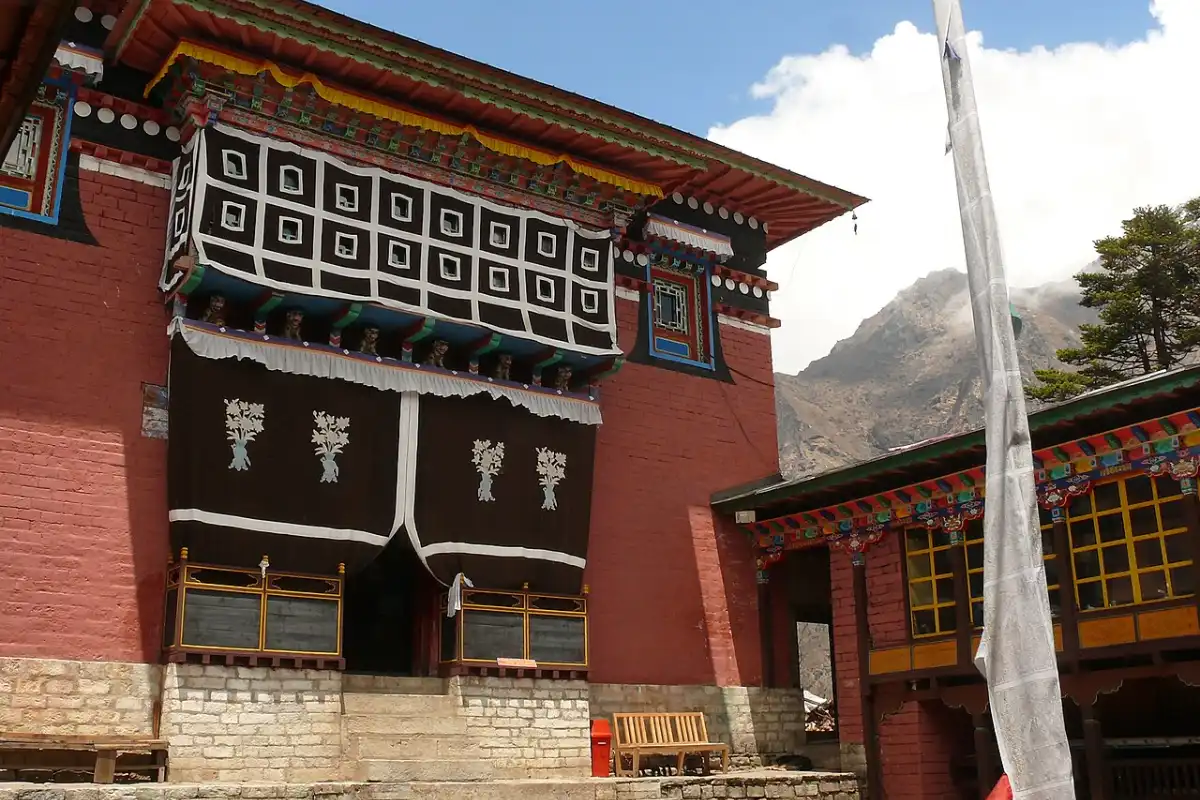
What you see today is mostly modern construction, built in the traditional style with stone walls, carved wooden windows and bright hand-painted interiors. For a wider look at how Buddhism shaped Sherpa life, read our guide to Sherpa culture and history.
What to See at Tengboche Monastery
The Main Prayer Hall (Dukhang)
Climb the stone steps from the courtyard, and you enter the main assembly hall. The centrepiece is a large statue of Shakyamuni Buddha, flanked by Manjushri (the bodhisattva of wisdom) and Maitreya (the future Buddha). The walls are covered in murals of protector deities, and long rows of low benches face the altar where the monks sit to chant. Photography inside is not allowed, so take it in properly.
The Courtyard and Entrance Gate
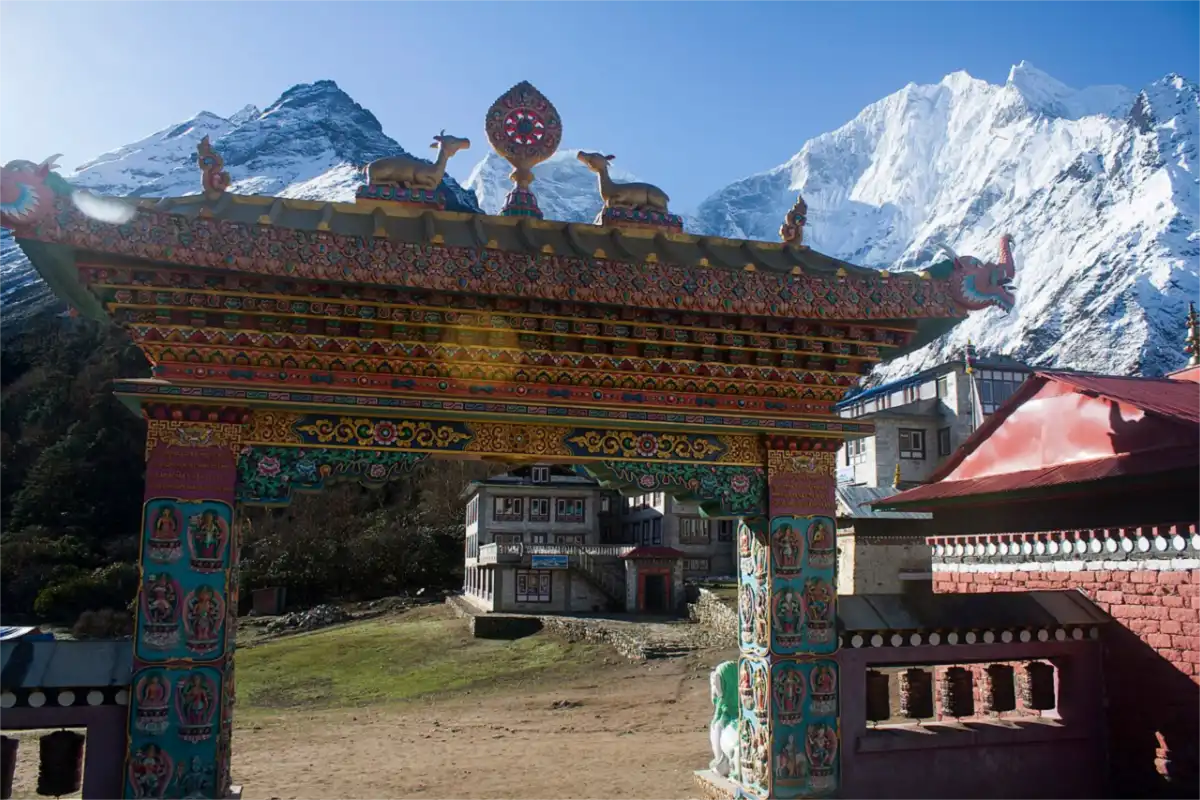
The large stone courtyard in front of the prayer hall is where Mani Rimdu dances take place and where trekkers gather for photos. The entrance gate, a kani painted with mandalas and deities, frames Ama Dablam perfectly when the sky is clear.
The Mountain Panorama
Tengboche has one of the best viewpoints on the whole Everest Base Camp route. From the meadow in front of the monastery, you can see Everest peeking over the Nuptse–Lhotse wall, with Ama Dablam (6,812 m) towering to the right and Thamserku and Kangtega behind you. Early morning gives the clearest view; by late morning clouds often roll up the valley. Set an alarm for sunrise. You will not regret it.
Tengboche Bakery and the Visitor Area
Yes, there is a bakery at almost 3,900 m, and apple pie with coffee after the long climb feels like a small miracle. A small cultural centre nearby has displays on Sherpa life and Buddhism, though opening hours are irregular.
Mani Rimdu Festival at Tengboche
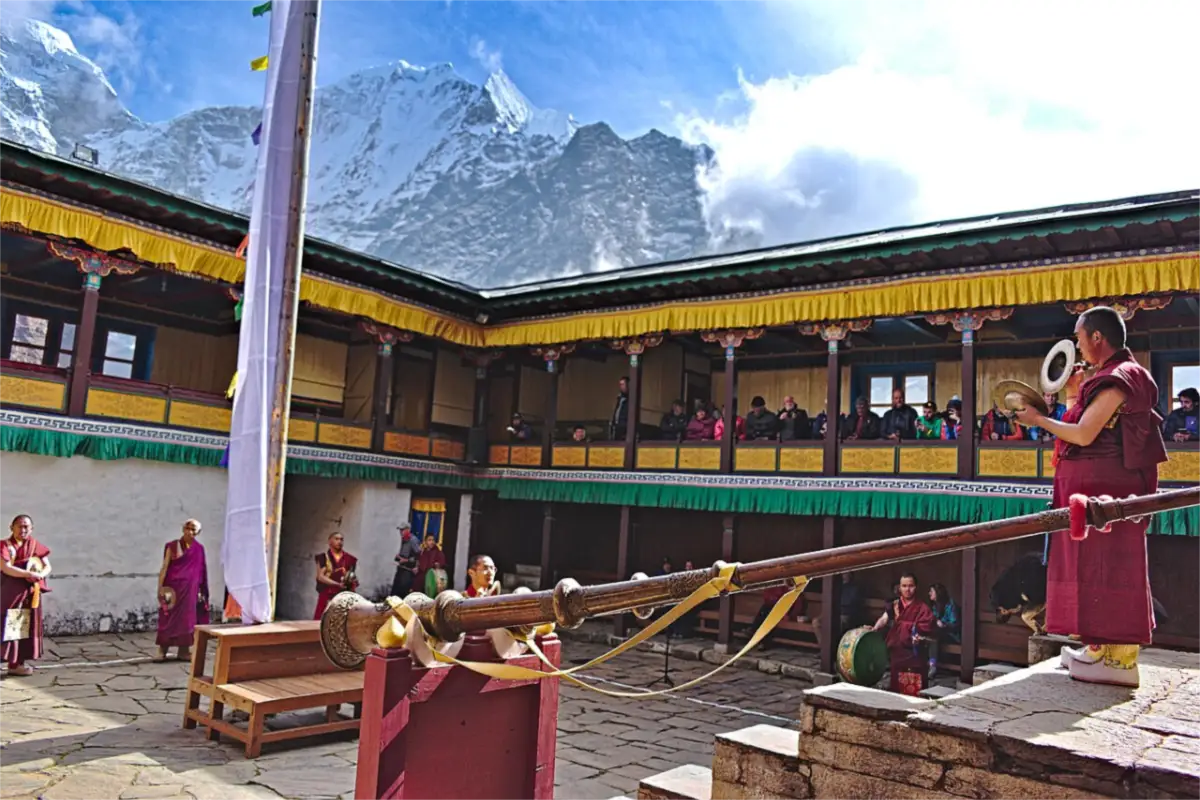
If you can time your trek right, Mani Rimdu is the best reason to linger at Tengboche. It is a series of sacred ceremonies held over about 19 days, with the last three open to the public. Monks wear elaborate brocade costumes and masks to perform cham, a ritual dance that represents the victory of Buddhism over the old Bon religion and the destruction of negative forces.
The public days usually go like this:
- Day one, Wang (empowerment): the head lama gives blessings and sacred pills to the crowd. Sherpas walk in from villages across the Khumbu, dressed in their best clothes.
- Day two, Cham (masked dances): the main event. Dancers representing deities, demons, and comic figures take over the courtyard for most of the day, with horns, cymbals and drums.
- Day three, Jinsak (fire puja): an offering ceremony where offerings are burned to remove harm from the world, followed by a final dance.
Mani Rimdu at Tengboche falls in the tenth month of the Tibetan lunar calendar, which usually means late October or November, right in peak trekking season. Dates change every year, and lodges fill up fast during the festival, so confirm dates and book early. Smaller versions of Mani Rimdu also take place at Thame Monastery in spring and Chiwong Monastery in the lower Solu region. We cover other celebrations in our guide to festivals of Nepal.
How to Reach Tengboche from Namche Bazaar
Most people walk from Namche Bazaar (3,440 m) to Tengboche in one day after acclimatising in Namche. It is about 10 km and 5 to 6 hours, in three parts:
- Namche to Kyangjuma and Sanasa (about 2 hours): a fairly level traverse along the hillside with the Dudh Koshi far below. Ama Dablam rises ahead, and you may spot Himalayan tahr or danphe, Nepal’s national bird. The trail to Gokyo splits off here at Sanasa.
- Sanasa down to Phunki Tenga (about 1 hour): a steep descent through pine and rhododendron forest to the river at roughly 3,250 m. Phunki Tenga has a few tea houses, a water-powered prayer wheel, and an army checkpoint. Eat lunch here.
- Phunki Tenga up to Tengboche (2 to 3 hours): the hard part. You regain about 600 m on a zigzag trail through the forest. Take it slowly and do not race the yaks.
If you are worried about the altitude, read our tips on preventing altitude sickness on the Everest Base Camp trek before you leave home.
Prayer Times and Visiting Hours
Tengboche is a monastery first and a tourist attraction second. The monks usually gather for prayers early in the morning (around 6 am) and again in the afternoon (often around 3 pm). Times shift with the season and with special ceremonies, so ask at your lodge the evening before.
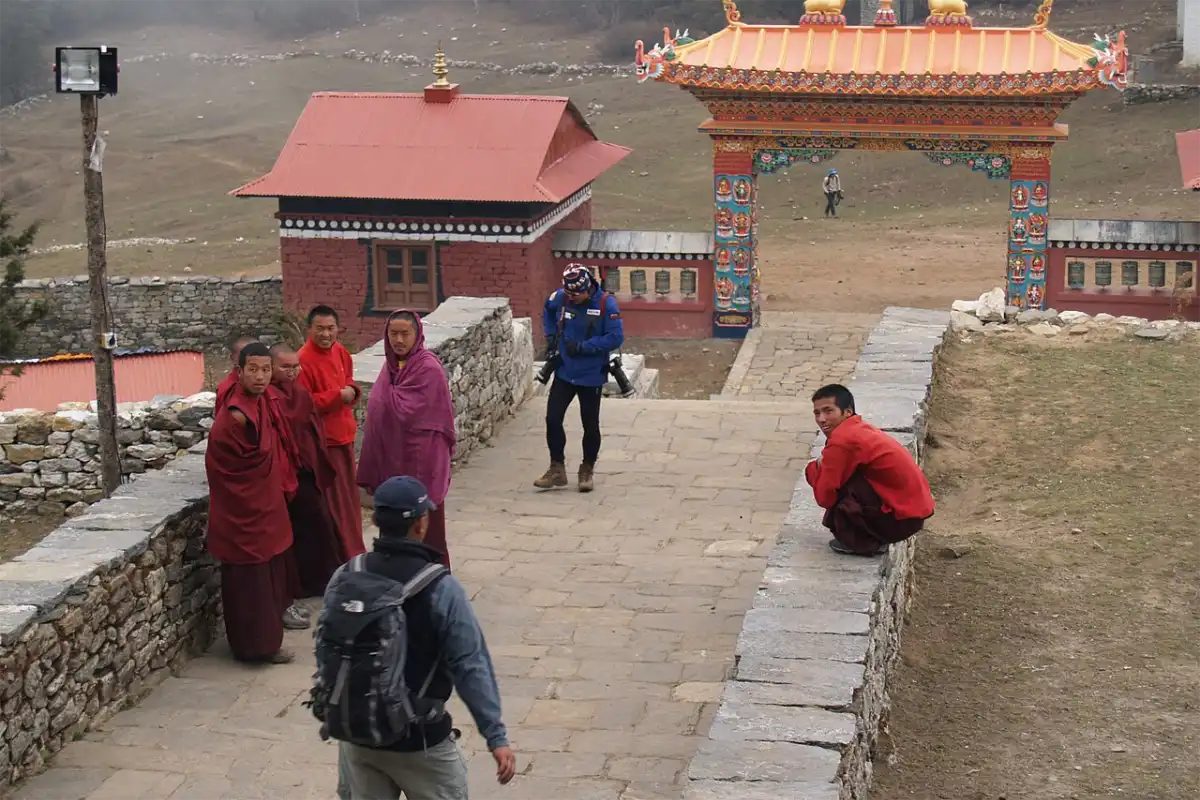
Sitting quietly at the back of the hall during puja, with the deep chanting and the drone of the long horns, is one of the most memorable moments of the trek. There is usually a small entry fee or donation for the main hall, a few hundred rupees at most. Carry small notes. Our guide on how much cash to carry on a Nepal trek explains why ATMs above Namche are unreliable.
Monastery Etiquette: Do’s and Don’ts
- Take off your shoes and hat before entering the prayer hall.
- Walk clockwise around the monastery, stupas, mani walls, and prayer wheels.
- No photos or videos inside the hall; outside, ask before photographing monks.
- Do not touch statues or offerings, and never point your feet towards the altar.
- Stay quiet during prayers and do not fly drones over the monastery.
Visiting more gompas? Our article on Buddhist monasteries in Nepal lists more places worth seeing.
Best Time to Visit Tengboche
Autumn (late September to November) is the classic season. Skies are clear after the monsoon, the views are sharp, and Mani Rimdu falls in this window.
Spring (March to May) is the other great season. The forest between Phunki Tenga and Tengboche turns red and pink with rhododendron blossoms, and days are warm.
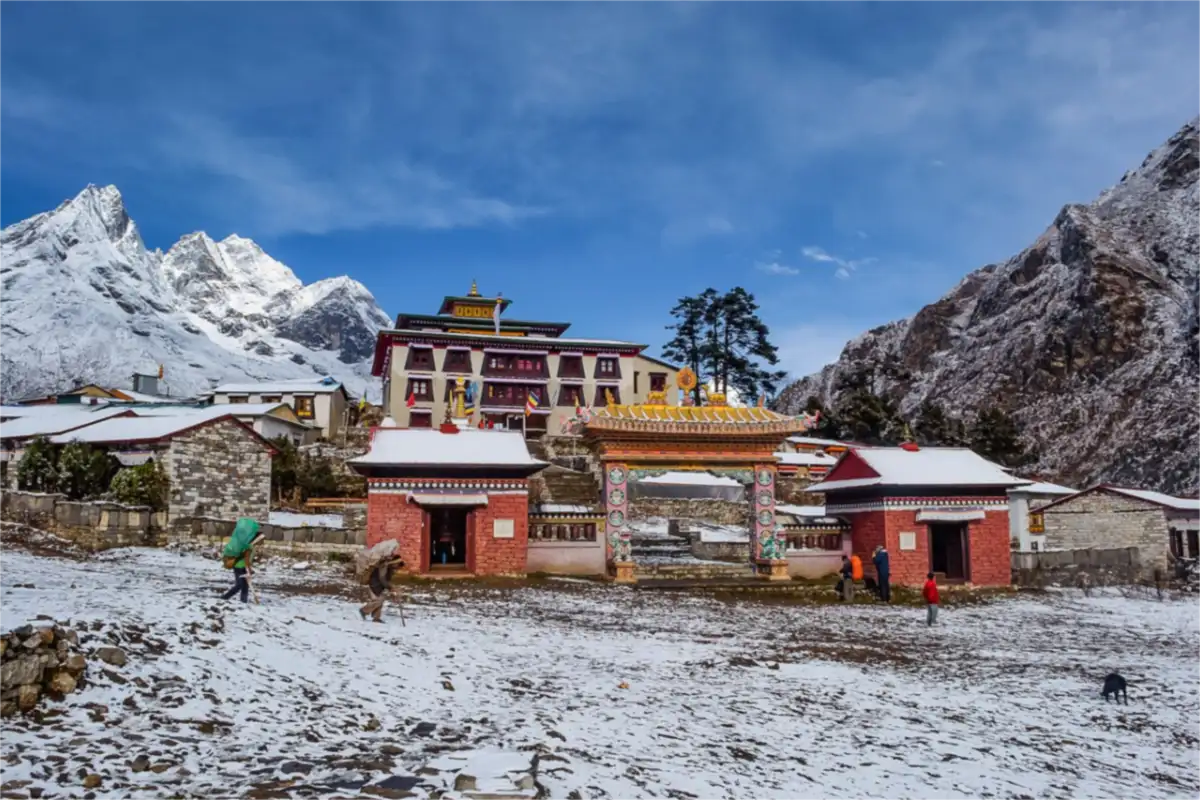
Winter (December to February) is cold, with nights well below freezing and the occasional snowfall, but the trail is quiet and mornings are often crystal clear. Some lodges close. Monsoon (June to August) brings rain, leeches lower down, cloudy views, and frequent flight delays at Lukla. For month-by-month details, see our guide to weather and climate for trekking in Nepal.
Where to Stay: Tengboche or Deboche?
Tengboche has only a few lodges, and they are basic but comfortable. The big advantage of sleeping here is waking up next to the monastery for sunrise and morning prayers.
Deboche (about 3,820 m), 20 minutes down the trail towards Pangboche, has more choice and a few newer lodges with attached bathrooms. It sits in a quiet forest and is home to a small Buddhist nunnery that is worth a short visit.
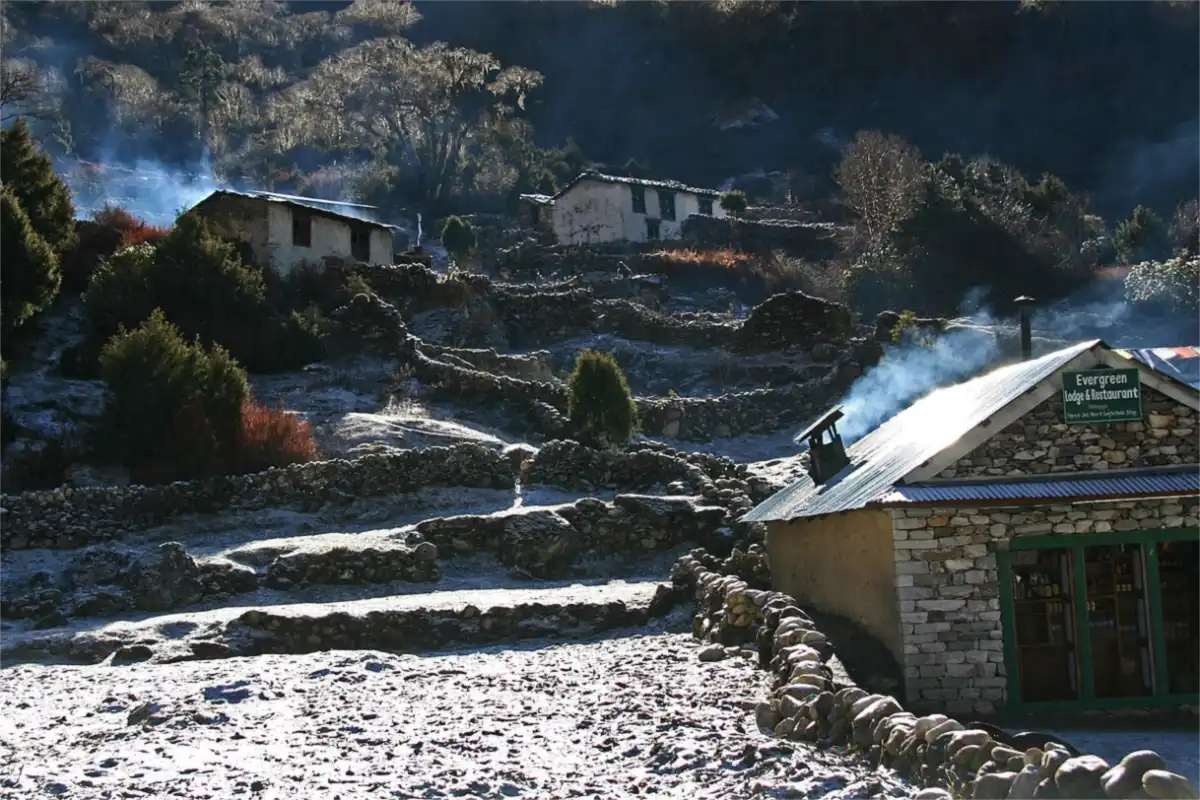
Expect simple twin rooms (bring a warm sleeping bag) and the usual menu of dal bhat, noodles and soups. New to the mountains? Our guide to tea house trekking in Nepal explains how it all works.
Permits You Need
You do not need a special ticket to visit Tengboche itself, but you need the standard Everest region permits:
- Sagarmatha National Park entry permit, paid at the park office in Monjo or in Kathmandu.
- Khumbu Pasang Lhamu Rural Municipality fee, paid in Lukla or Monjo.
Together, these cost roughly US$40 to $50 for foreign trekkers at current rates. Fees change from time to time, so check the latest figures in our Nepal trekking permit guide. If you trek with Nepal Footprint Holiday, we arrange all permits for you.
How Tengboche Fits Into Your Everest Itinerary
On a standard Everest Base Camp trek, Tengboche is the overnight stop on day four, after Phakding, Namche, and an acclimatisation day. From there, the trail continues to Dingboche, Lobuche, Gorak Shep, Everest Base Camp, and the famous sunrise viewpoint at Kala Patthar. On the way down, you will pass Tengboche again, and many trekkers enjoy it even more the second time, fit and acclimatised, with time to sit in the courtyard and simply look.
Short on time? The Everest Panorama Trek makes Tengboche its high point, giving you the monastery, the Everest views and Sherpa culture in nine days, without the high-altitude nights further up the valley. If you want to see more of the Khumbu, the Everest High Passes Trek passes through Tengboche on its way to the three big passes. Not sure which route suits you? Compare EBC vs Gokyo Lakes, check the total cost of the Everest Base Camp trek, and get fit with our EBC training plan.
Frequently Asked Questions About Tengboche Monastery
How high is Tengboche Monastery?
Tengboche Monastery is at about 3,867 m (12,687 ft) above sea level. Some maps round it to 3,860 m.
Can you see Everest from Tengboche?
Yes. On a clear day you can see the summit of Everest above the Nuptse–Lhotse ridge, together with Ama Dablam, Lhotse, Thamserku and Kangtega. Mornings usually give the best view.
Can tourists go inside Tengboche Monastery?
Yes. Visitors can enter the main prayer hall and sit in on the morning or afternoon prayers, as long as they remove their shoes, stay quiet, and do not take photos inside.
Do I need a guide to visit Tengboche?
Nepal tightened its rules on solo trekking in 2023, and how they are enforced varies by region, so check the current situation before you go (our solo trekking in Nepal guide explains the options). Either way, a local guide helps you understand the rituals and history of the monastery, which makes the visit far more meaningful.
Final Thoughts
Plenty of people trek to Everest Base Camp for the mountain and come home talking about Tengboche. It is where the trek stops being only a physical challenge and becomes a journey into a living culture, with monks chanting at dawn and the world’s highest peaks watching over it all.
Take your time here. Stay the night, go to the morning prayers and sit in the courtyard with a cup of tea. If you would like help planning an Everest trek that gives Tengboche the time it deserves, get in touch with the Nepal Footprint Holiday team, and we will build an itinerary around you.