

The Annapurna Base Camp trek in winter runs from December through February, offering snow-draped trails, sharp mountain views, and quiet trails, but it demands proper gear and an experienced guide for temperatures that fall to -15°C at base camp.
The Annapurna Base Camp trek winter season is one of Nepal’s best-kept secrets. Spring and autumn are the most popular windows, and rightly so. However, winter at the Annapurna Base Camp Trek offers something the peak seasons simply cannot: silence, deep snow, and a Himalayan sanctuary almost entirely to yourself. Our team has guided trekkers to ABC every month of the year. We know exactly what December, January, and February look like on the ground. This guide shares that knowledge in full.
Furthermore, winter trekking in the Annapurna region is growing in popularity. Many experienced trekkers choose it specifically to avoid the October and November crowds. The trails are quieter. The skies are often strikingly clear. Snow transforms the rhododendron forest and glacial basin into a landscape unlike any other season.
Is the Annapurna Base Camp Trek Possible in Winter?
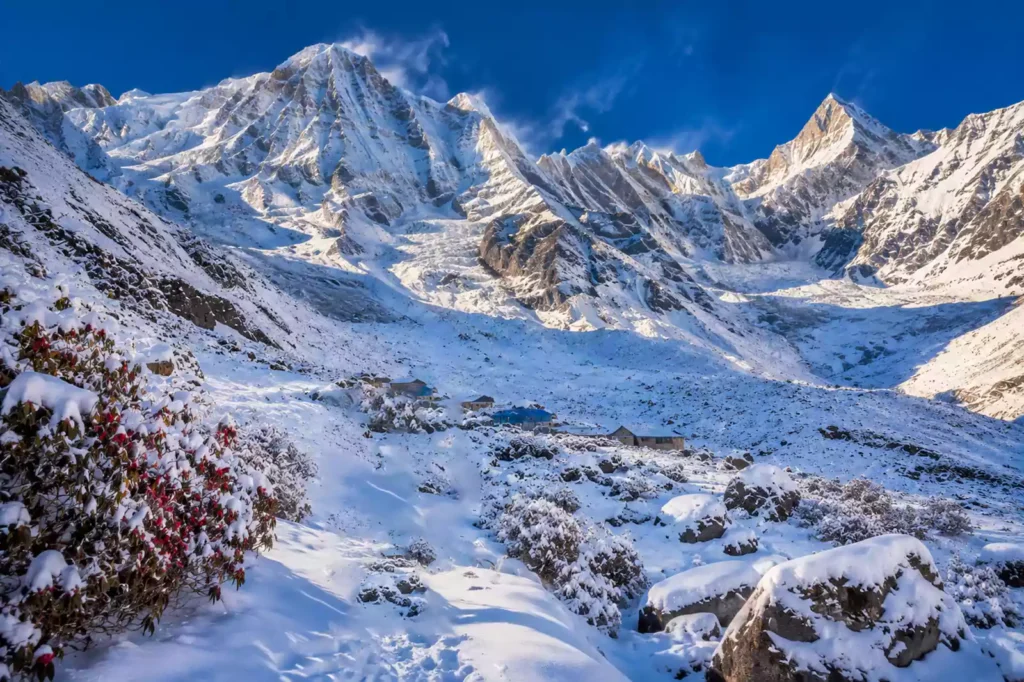
Yes, the Annapurna Base Camp trek is possible in winter. The route stays open throughout December, January, and February. However, conditions vary significantly by altitude and month. The lower trail from Nayapul (1,070 m) to Chhomrong (2,170 m) stays walkable with minimal snow. Above Chhomrong, snow builds steadily. By Deurali (3,230 m) and Machhapuchhre Base Camp (3,700 m), the trail can carry 30 to 90 cm of snow depending on recent falls.
Additionally, most tea houses remain open in December. In January and February, some lodges at higher elevations close due to low footfall. Our guides confirm tea house availability before every winter departure, so there are no unpleasant surprises mid-trail.
What Are Temperatures Like on the Winter ABC Trek?
Temperature is the most important factor to understand before planning a winter ABC trek. The table below shows what to expect at key points along the route:
| Location | Altitude | Day Temp (°C) | Night Temp (°C) |
| Pokhara | 822 m | 15 to 20 | 5 to 8 |
| Chhomrong | 2,170 m | 8 to 12 | -2 to 2 |
| Himalaya Hotel | 2,900 m | 3 to 7 | -6 to -2 |
| Machhapuchhre Base Camp | 3,700 m | -2 to 4 | -10 to -6 |
| Annapurna Base Camp | 4,130 m | -5 to 2 | -15 to -10 |
Daytime temperatures at lower elevations are manageable. At ABC itself, nights are genuinely cold. Without a sleeping bag rated to at least -15°C and proper layering, the experience becomes uncomfortable and potentially dangerous. Consequently, our team sends every winter trekker a detailed gear checklist before departure.
What Are Trail Conditions Like Month by Month?
December: The Most Reliable Winter Month
December is the best entry point into the Annapurna Base Camp trek winter trekking. Early December conditions resemble late November. Snow is limited below 3,000 m, tea houses are fully stocked, and views of Annapurna I (8,091 m), Annapurna South (7,219 m), and Machhapuchhre (6,993 m) are frequently spectacular. Post-monsoon clarity lingers well into early December. Therefore, if you want a genuine winter experience with the lowest risk, December is the month our guides recommend most.
January: Deep Winter at High Altitude
January is the coldest and most demanding month on the trail. Snowfall is heaviest above Bamboo (2,310 m). Sections between Deurali and ABC can be difficult to follow without a guide who knows the route under snow. The upper section near Machhapuchhre Base Camp demands careful footwork on icy patches. Nevertheless, January also produces the most dramatic scenery of the year. The snowfield at ABC, surrounded by the Annapurna massif in full winter white, is extraordinary.
February: Winter Easing Toward Spring
February sits between deep winter and early spring. Snowfall eases in the second half of the month. Temperatures at ABC remain cold at night, but daytime conditions improve noticeably. Rhododendron buds appear on the lower trail sections. Additionally, tea houses begin preparing for the spring season, so facilities and food quality improve steadily. The second half of February suits trekkers who want a winter feel without January’s full severity.
What Gear Do You Need for a Winter ABC Trek?
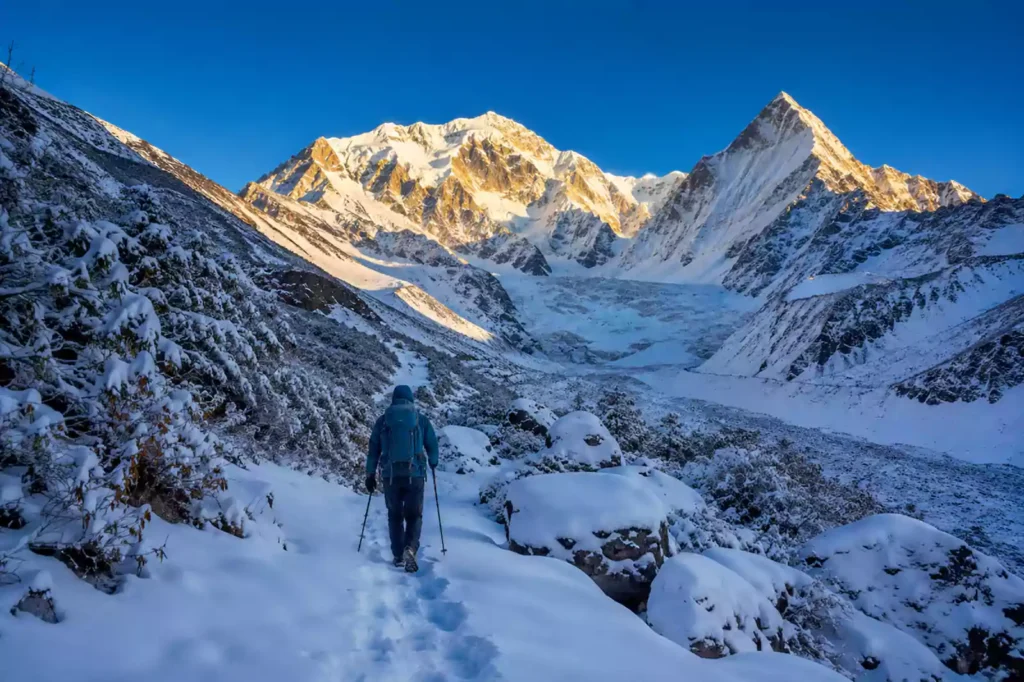
Packing correctly is non-negotiable. Our guides confirm every trekker carries the following before departing the upper trail:
- Sleeping bag: Rated to -15°C minimum. Never rely on tea house blankets above 3,000 m in winter
- Down jacket: High-loft, for evenings and early mornings at camp
- Base layers: Thermal top and bottom in moisture-wicking synthetic or merino wool
- Mid-layer: Fleece jacket for active trekking hours
- Waterproof shell: Wind and snowproof outer jacket and trousers
- Trekking boots: Waterproof, insulated, and well broken-in before the trek
- Gaiters: Essential above Deurali to keep snow out of boots
- Microspikes: Required for icy sections above Machhapuchhre Base Camp
- Trekking poles: With snow baskets attached
- Balaclava, warm hat, and layered gloves: Cold-weather hand and head protection is critical at ABC
You can rent or buy all of these in Kathmandu and Pokhara. Our full trekking equipment guide covers exactly what to bring for cold-weather Himalayan trekking.
Do You Need a Guide for a Winter ABC Trek?
Yes. Our team considers a licensed guide even more essential in winter than in peak season. Under Nepal’s 2025 mandatory guide regulation, introduced by the Nepal Tourism Board and TAAN (Trekking Agencies’ Association of Nepal), all foreign trekkers in the Annapurna Conservation Area must trek with a government-certified guide. In winter, this carries additional practical weight. Trail markers disappear under snow. Some paths become genuinely hard to follow without local knowledge. Our guides carry pulse oximeters, emergency communication devices, and full first-aid kits on every winter departure. Those considering solo trekking in Nepal in winter will find that our guide explains exactly why this matters in off-season conditions.
Is Altitude Sickness a Risk in Winter?
Altitude sickness risk does not change with the season. The summit at 4,130 m presents the same physiological challenge in January as in October. According to the Nepal Tourism Board, altitude symptoms can affect anyone above 2,500 m. Fitness level and time of year make no difference to that threshold.
What does change in winter is emergency response time. Colder temperatures and snow make a descent slower and more demanding. In addition, cold air can mask early altitude symptoms. Headaches and fatigue are easy to attribute to the cold rather than the altitude. Our guides are trained to recognise the difference and act immediately. Therefore, we follow a conservative ascent profile and check oxygen saturation at every overnight stop. Read our altitude sickness guide before booking any high-altitude winter trek.
How Does a Winter ABC Trek Compare to Peak Season?
| Factor | Winter (Dec–Feb) | Peak Season (Oct–Nov, Mar–May) |
| Trail crowds | Very low | High to very high |
| Snow on trail | Moderate to heavy above 2,500 m | None too light |
| Mountain views | Excellent on clear days | Excellent |
| Tea house availability | Limited above 3,000 m in Jan–Feb | Full availability |
| Night temp at ABC | -15 to -10°C | -5 to 0°C |
| Gear required | Advanced cold-weather kit | Standard trekking kit |
| Cost | Slightly lower off-season rates | Standard or higher |
| Best for | Experienced trekkers | All experience levels |
The biggest advantages are solitude and snow. The biggest risks are cold and trail difficulty at high elevation. Both are manageable with the right gear and guide. Trekkers who have done the Khopra Danda Trek or the Jomsom Muktinath Trek in cooler months often see winter ABC as a natural next step.
What Permits Do You Need for a Winter ABC Trek?
Permit requirements are the same year-round. You need an Annapurna Conservation Area Permit (ACAP) at NPR 3,000 (approximately USD 22) per person and a TIMS card at NPR 2,000 (approximately USD 15) for individual trekkers. Our guides collect both before the first step. See our trekking permit guide for the current process.
How Much Does a Winter ABC Trek Cost?
A fully guided 9-day private winter ABC trek costs between USD 700 and USD 1,000 per person. This covers a licensed guide, porter, all accommodation, three meals per day, permits, and ground transport. Winter tea house rates are slightly lower than peak season, though guide and porter costs remain the same year-round. For shorter options, our short treks in Nepal page lists lower-elevation Annapurna routes accessible even in the coldest months.
For the full day-by-day itinerary and booking details, visit our Annapurna Base Camp Trek page. Ready to plan your winter departure? Send us an inquiry, and our team will respond within 24 hours with a custom quote.
“Winter is when the Annapurna Sanctuary reveals its most dramatic face. The crowds are gone, the snow is deep, and the mountains feel enormous. Every trekker who does it in December or January tells us it was unlike any trek they had done before.” — Nepal Footprint Holiday senior guide, Annapurna region specialist with 13 years of field experience.
Frequently Asked Questions About the Annapurna Base Camp Trek in Winter
Q1. Is the Annapurna Base Camp trek safe in winter? Yes, with the right preparation. You need a licensed guide, a sleeping bag rated to -15°C, waterproof insulated clothing, and microspikes above 3,500 m. Trail progress is slower than in peak season. Our team has completed winter ABC departures safely every year for over a decade.
Q2. Which month is best for the Annapurna Base Camp trek in winter? December is the most reliable month. Early December combines manageable snow with excellent visibility and fully open tea houses. January brings the most dramatic snow scenery but also the coldest temperatures. February improves steadily through the month as conditions ease toward spring.
Q3. How much does the Annapurna Base Camp trek cost in winter? A fully guided 9-day private winter ABC trek costs between USD 700 and USD 1,000 per person. This includes a licensed guide, porter, accommodation, meals, permits, and transport. Winter off-season rates at tea houses are slightly lower than peak season.